Watching Picnic at Hanging Rock in a room I could not leave
Three women vanish into a landscape that does not want them, and I watched it from a flat with no balcony in Fitzroy.
I watched Picnic at Hanging Rock on a Tuesday in September, which was also a Wednesday, which was also every other day that month. Melbourne’s second lockdown had flattened the week into a single repeating surface. I was in a one-bedroom flat in Fitzroy with no balcony, a window that faced a brick wall, and a laptop balanced on a pillow because the desk was covered in unopened mail. The film was not a choice so much as a gravity. It had been sitting in my watchlist since March, and I had run out of ways to avoid it.
I want to say I chose it for intellectual reasons. I want to say I was thinking about Peter Weir’s early work, or the Gothic tradition in Australian literature, or the formal relationship between landscape and the uncanny. What I mean is I pressed play because I had already watched everything else and the algorithm surfaced it, and I thought: fine.
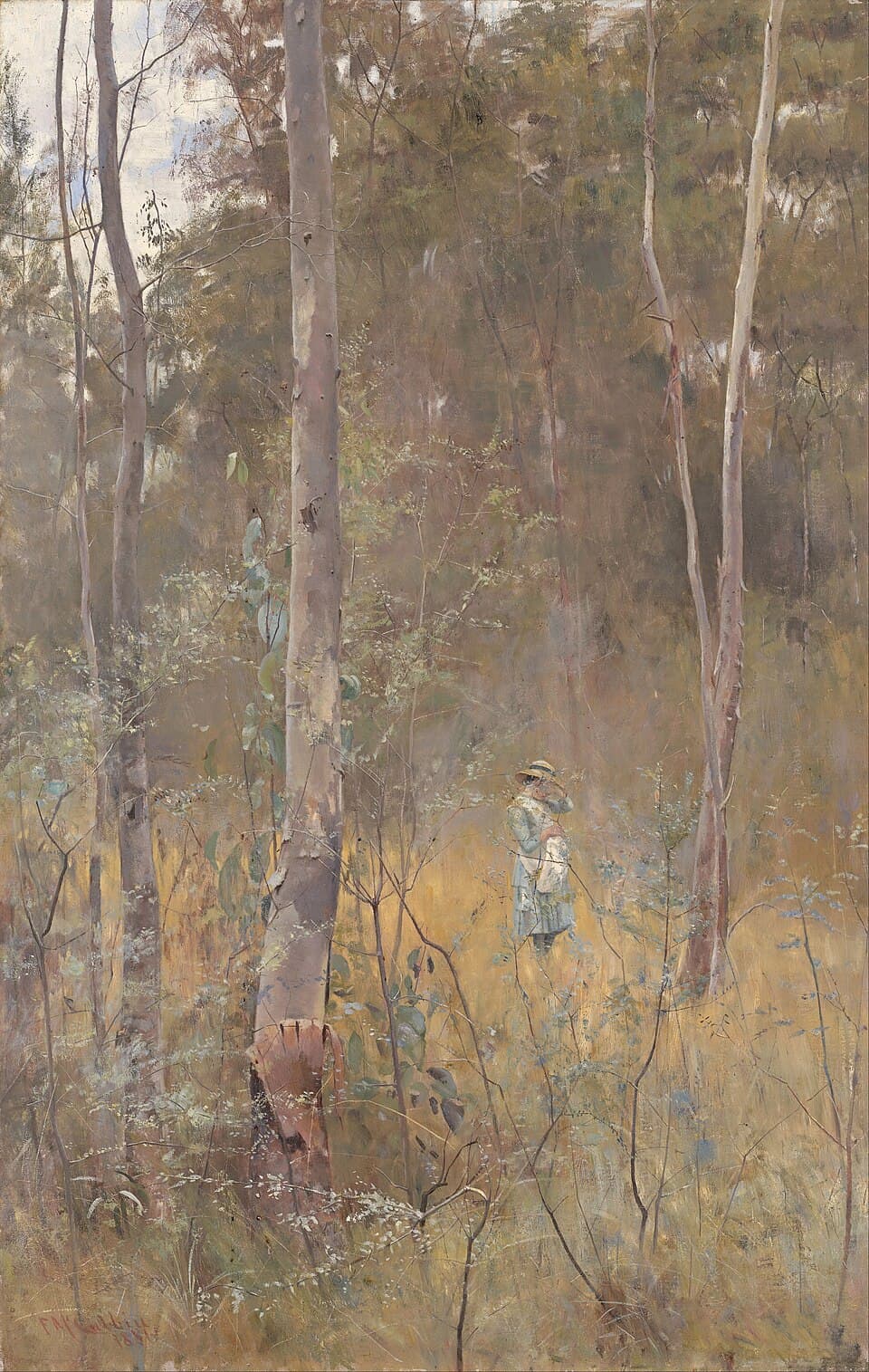
The film opens with light. That is the first thing I noticed, or rather, the first thing that hurt. The light at Hanging Rock is absurdly beautiful, the kind of golden colonial light that Australian tourism boards have been selling for decades, and it poured through my screen into a room where I had not seen direct sunlight in four days. The girls in their white dresses move through the bush like something from a Renoir painting that wandered into the wrong country. They are so free it is almost aggressive.
The rock does not care about you
Three of the girls and their mathematics teacher walk up the Rock and do not come back. This is the whole film. There is no explanation, no resolution, no third-act reveal where someone finds a body or confesses. They simply vanish into the landscape, and the landscape does not flinch. The Rock was there before them and it will be there after, and it does not care about corsets or Empire or the school’s reputation or the constable’s investigation.
I have thought about this a lot, sitting in my flat. The Rock does not care about lockdown either. The Rock does not care about Dan Andrews or Stage Four or the 5-kilometre radius or my mental health. The Rock is 6 million years old. This is, depending on your mood, either comforting or terrifying. In September 2020, it was both.
Weir understood something about the Australian landscape that most Australian films still struggle with: it is not a backdrop. It is not a setting. It is the thing itself. The country (and I use that word deliberately, in the way that First Nations people use it, meaning something alive and specific and older than the idea of property) does not exist to frame human drama. Human drama happens inside it, sometimes, briefly, and then the country goes on without you.
Confinement as a way of seeing
There is a particular cruelty to watching a film about open space when you cannot go outside. I do not mean this in a self-pitying way, or not only in a self-pitying way. I mean it formally. Lockdown changed how I watched the film. Every wide shot of the Victorian bush became a taunt. Every scene where a character simply walks became a fantasy. I found myself pausing on landscape shots, not to analyse them but to breathe them, the way you might hold a glass of water up to the light just to see something clear.
The girls at Appleyard College are also confined, of course. That is the point. They live inside Mrs Appleyard’s suffocating Englishness, inside corsets and timetables and the fiction that the colony is a smaller, hotter version of Surrey. The picnic is a release valve. When Miranda and the others walk up the Rock, they are walking out of the frame that the Empire built for them. They are walking into country.
I grew up on films that treated the Australian landscape as hostile. In the seventies and eighties, the bush was where bad things happened: cars broke down, men went feral, children were taken by dingoes (or not). The landscape was an antagonist. What Weir does in Picnic at Hanging Rock is stranger and more unsettling. The landscape is not hostile. It is indifferent. It simply absorbs the girls the way a lake absorbs a stone. No malice, no motive, no plot. Just geology.
The flat, the frame, the fifth month
By October I had watched the film three times. This is not something I am proud of. Or maybe it is. I am not sure what pride means in the context of a pandemic, when getting dressed counts as an achievement and watching a fifty-year-old film on repeat is either a coping mechanism or a research methodology, depending on which grant application you are filling out.
What I kept coming back to was the disappearance itself. Not the mystery of it (Weir is not interested in mystery, despite what the marketing says) but the mechanics. The girls walk up. The camera watches. The girls do not walk back. The camera keeps watching. The Rock remains. That is it. No cut to a scream, no ominous music sting, no villain. Just presence, then absence, then landscape.
I thought about all the people I had not seen in months. Not disappeared, obviously. Not gone in any real sense. But absent from my life in a way that felt, on bad days, permanent. The lockdown had this quality of the uncanny about it: everyone was still alive, still technically reachable by phone or Zoom, but the physical fact of them had been subtracted from my world. They existed as voices, as pixels, as text messages at 2 a.m. that said “are you okay” and meant “I am not okay.”
Coming down from the Rock
The film ends without resolution, and so did the lockdown, in a way. There was no single day when it was over. There were stages, easing, press conferences, dates that shifted. One day I walked further than five kilometres and nothing happened. No alarm, no fine, no constable. Just more footpath, more sky, more of the country that had been there the whole time, not waiting for me exactly, but not refusing me either.
I have not watched Picnic at Hanging Rock since. I do not need to. It lives in my body now, in that specific way that certain films do when you watch them at the wrong time, which is also the right time. The Rock is still there. The girls are still gone. The landscape is still indifferent. I can go outside whenever I want, and most days I do, and some days the sky is so wide and careless that I think of Miranda walking upward into the light, and I understand, for a second, why she did not come back.

Mara writes essays. She came to film writing from a decade of literary criticism and still reaches, sometimes, for a novel before she reaches for a shot list. She lives in the inner north of Melbourne and does not explain which city that is.
MORE BY MARA DENG →
Australian cinema keeps filming the outback and forgetting the towns in between
The films get made in Sydney and Melbourne, the stories get set in the outback, and the actual regional cities where most Australians live barely appear at all.
Australian cinema keeps going back to drought because drought never really left
The dry country is not a backdrop; it is a condition, and Australian film returns to it the way a tongue returns to a broken tooth.
The year ended and I still had not gone back to the cinema
Cinemas reopened in November and I watched three films on my laptop in December and I am not sure what that says about me.