Nude Tuesday speaks a language nobody understands and that is the whole experiment
The NZ/Australian comedy is performed entirely in a made-up language with subtitles, and the gap between what you hear and what you read is where the comedy lives.
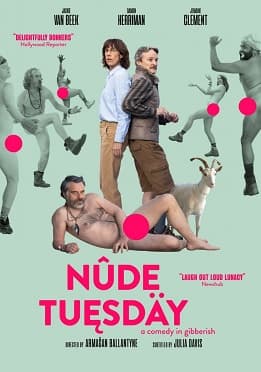
The dialogue in Nude Tuesday is nonsense. I mean that literally. The actors are speaking a made-up language, a kind of melodic gibberish that sounds vaguely Scandinavian if you are not listening closely and sounds like absolutely nothing if you are. The words have no meaning. They were improvised on set by the cast, who were given scenarios and emotional beats and told to speak in whatever sounds felt right. The sounds are then subtitled, and the subtitles were written not by the filmmakers but by a comedian, and the comedian’s interpretation of the gibberish becomes the script the audience reads.
This is the central formal proposition of Armagan Ballantyne’s film, and it is either the cleverest structural joke in recent antipodean comedy or a one-note gimmick stretched past its natural duration. I have been thinking about which one it is since I watched it, and I have concluded, reluctantly, that it is both.
The film itself is about a couple in crisis. Laura (Jackie van Beek) and Bruno (Damon Herriman) go to a relationship retreat run by a charismatic wellness guru. The retreat is located somewhere that looks like rural New Zealand dressed up as continental Europe. The guru is played by Jemaine Clement with the benign menace of a man who has read one book about tantra and decided it made him a prophet. The comedy is broad, physical, occasionally scatological, and deeply committed to the premise that all human attempts at self-improvement are fundamentally ridiculous.
The gap between sound and meaning
The gibberish is the thing. Everything else in Nude Tuesday is competent but familiar. We have seen the couples-retreat comedy before. We have seen the wellness-guru satire. We have seen Jemaine Clement doing his particular brand of deadpan spiritual fraud. What we have not seen, or at least not in this form, is a comedy that locates its humour in the space between what the actors are doing and what the audience is told they are saying.
The effect is strange and intermittently wonderful. Van Beek delivers a line of gibberish with the cadence and emotional weight of a confession, and the subtitle reads as something banal or absurd or filthy, and the collision between the two registers produces a laugh that is different in kind from a conventional comedy laugh. It is a laugh of recognition, of the gap between what we intend and what is understood, of the fundamental unreliability of language as a vehicle for meaning. In its best moments, the film is doing something genuinely interesting about communication, about the way couples talk past each other, about the way therapeutic language obscures rather than reveals.
In its worst moments, the gimmick is just a gimmick. The gibberish sounds funny for about twenty minutes and then the ear adjusts and it becomes wallpaper. The subtitles, which were written by Julia Davis for the version I saw, are sharp but inconsistent, brilliant in some scenes and merely adequate in others. The concept was designed to generate multiple versions of the film, with different comedians providing different subtitle tracks, each one producing a different movie from the same footage. It is a conceptually elegant idea that has a practical problem: the audience can only watch one version at a time, and the version they watch needs to work as a coherent film, not just as a demonstration of a concept.
The performers in the fog
Jackie van Beek is good. She has a quality that I associate with the best New Zealand screen actors, a kind of pragmatic emotional honesty, a refusal to signal that a moment is funny or sad or significant, a trust that the audience will find the register without being told. She plays Laura as a woman who has given up on her marriage but not quite admitted it to herself, and the gibberish, paradoxically, helps her performance. Freed from the constraint of specific words, she builds the character through rhythm and gesture and physical precision, and the result is more expressive than a lot of conventionally scripted comedy performances.
Herriman, who is Australian and who has spent the last several years doing extraordinary character work in American productions, plays Bruno as a man who is trying. Just trying. Trying to be a good husband, trying to be open to the retreat experience, trying to understand what his wife wants. He is the straight man in a film that has no straight material, and he holds the centre by being the person in the room who most wants the language to mean something, even though he knows it does not.
Clement does what Clement does, which is to be simultaneously ridiculous and slightly frightening, and the wellness-guru role fits him the way a tailored robe fits a man who believes in his own divinity. He is funny. He is always funny. But his performance sits slightly outside the film’s central experiment because his comic persona is so established that the gibberish does not defamiliarise him the way it defamiliarises the other actors. You watch Clement and you hear Clement, regardless of what language he is nominally speaking.
The co-production question
Nude Tuesday is a New Zealand/Australian co-production, which means it was funded through the screen agencies of both countries and shot with a mixed crew and cast drawn from both sides of the Tasman. The co-production model is interesting here because the film’s central conceit, a cast speaking a language that belongs to no country, is a neat accidental metaphor for the co-production itself. The film has no national voice. It is not identifiably New Zealand or Australian in its setting, its accent, its cultural references, because it has no accent and no cultural references. It exists in a linguistic nowhere, and that nowhere is the most honest representation of the trans-Tasman creative relationship I have seen in a while.
Whether the concept is enough
My assessment, which I offer with genuine ambivalence, is that the concept of Nude Tuesday is smarter than its execution, but the concept is smart enough to matter. The idea of a film performed in gibberish, subtitled by a comedian who is interpreting the actors’ emotional output without access to their intended meaning, is a genuine contribution to the formal vocabulary of screen comedy. It says something real about how we communicate, about the distance between intention and reception, about the way meaning is constructed by the listener as much as the speaker. That is worth a film.
The film itself is uneven. The middle sags. The retreat plot follows a predictable arc that the language experiment cannot fully disrupt. The tonal register, which should be wild and unpredictable given the freedom the gibberish affords, settles into a comfortable absurdism that feels safer than the concept demands. I wanted the film to be braver with its own idea, to push the disjunction between sound and subtitle into territory that was truly uncomfortable or truly profound, and it mostly stays in the zone of amiable weirdness.
But amiable weirdness, delivered with this much formal intelligence, is not nothing. Nude Tuesday is a film I respect more than I enjoyed, and the respect is for the question it asks rather than the answer it arrives at. The question is: what happens when you take language away from comedy? The answer, it turns out, is that comedy survives, because comedy was never really about the words. It was about the gap between what we mean and what we say, and that gap does not require a real language. It requires only the knowledge that understanding is always, at best, approximate.
Bronte writes long-form criticism of Australian cinema and the international art films that feed into it. She was on the ground at Cannes in 2019 and has not entirely forgiven the festival for 2020. Patient with slow films; impatient with tidy ones.
MORE BY BRONTE HAUGHEY →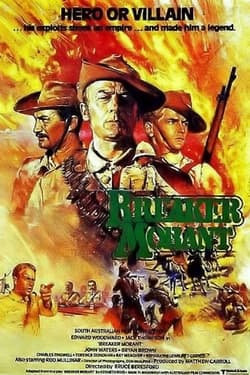
Breaker Morant and the country that adopted its scapegoat
Bruce Beresford's 1980 courtroom drama made an English-born soldier into an Australian martyr, and the picture's argument about empire has outlived its historical certainties.
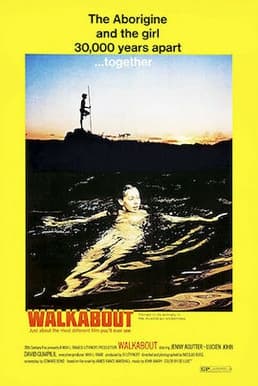
Walkabout is a British film about a country it never claims
Nicolas Roeg's 1971 picture is claimed as an Australian classic, though it was made by a Londoner, financed by two Americans and sold by 20th Century Fox. Its best argument is how little it pretends otherwise.
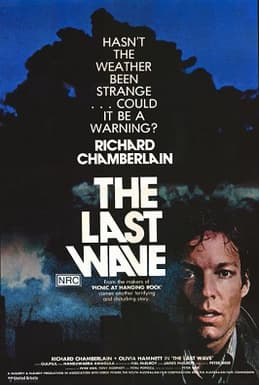
The Last Wave and the rain Sydney could not explain
Peter Weir's 1977 film puts a corporate lawyer in a drowned city and asks what a settler place owes to the ground and weather beneath it.