The Last Wave and the rain Sydney could not explain
Peter Weir's 1977 film puts a corporate lawyer in a drowned city and asks what a settler place owes to the ground and weather beneath it.
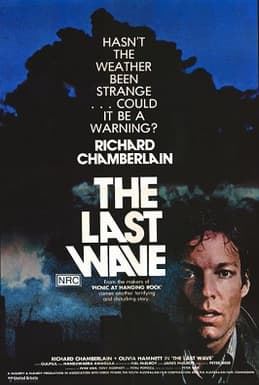
The strangest thing in The Last Wave is not the black rain, or the hail that falls from a clear sky on an outback school. It is the way the film’s hero, a Sydney corporate lawyer played by Richard Chamberlain, goes on explaining the weather to himself long after the picture has stopped believing his explanations. The register of the film is a man being polite to a catastrophe.
Peter Weir made it in 1977, two years after Picnic at Hanging Rock, with a budget of A$818,000, and it sits a little to one side of the Australian New Wave’s usual preoccupations. It is not a story about the bush as threat, which is the older Australian Gothic. It is about a harbour city in a drought-breaking storm, and about the people who were already living on the ground before the harbour was built.
A city in the wrong weather
David Burton is a solicitor of the kind Sydney produces in quantity: comfortable, decent, mostly occupied with the business of other people’s money. He is asked to take on the defence of five Aboriginal men in the city accused of killing another, a man who, it turns out, died in a manner the accused will not describe to a court. The case is the pretext. What Weir is filming is the slow disorientation of a man who finds that his own dreams, and the sky over Sydney, are describing something he is not equipped to read.
The weather is the film’s argument. It rains where it should not. It rains black. Weir, working with the cinematographer Russell Boyd, who had also shot Picnic, lights the city in a deep, wet grey that makes the suburbs look like a place under observation. The light is the true special effect in the film. By the time the supernatural arrives, the audience has already been convinced that the sky has a point of view.
Production ran in Adelaide and Sydney, beginning in late February 1977, and the geography is not incidental. The film’s Sydney is a corporate city of towers and car parks that has been laid over older sites, and its most frightening scenes happen beneath the pavement.
Two men who know more than the film says
The film’s greatest trick is to make the hero’s ignorance, rather than the strangers’ knowledge, the thing that frightens us. Weir does not give the audience a guide to Aboriginal law. He gives it Burton, who has no guide either, and he lets the man’s polite curiosity gradually turn to dread.
The two performances that matter most are the ones in which the film refuses to explain itself. David Gulpilil, who had been the quiet centre of Walkabout six years earlier, plays Charlie, a young man who seems to know why the water is coming and will not say. Nandjiwarra Amagula, a Northern Territory elder, plays Chris Lee, the older figure who holds the key to the ritual that Burton keeps stumbling toward. Amagula’s presence is unlike anything in the Australian cinema of the 1970s: he does not play at gravity, he has it, and Weir has the good sense to film it with long, still close-ups that do not ask him to act.
Both men are written, in the script by Weir, Tony Morphett and Petru Popescu, with a certain reticence, and I think that is correct. The film is not a portrait of Aboriginal religion; it is a portrait of the limit of a white lawyer’s access to it. Contemporary viewers are right to notice what is missing, and the film’s reticence is a form of honesty about that.
What the film knows about Sydney
The picture’s lineage is complicated. It owes something to the English ghost story, where the rational man is undone by evidence. It owes something to Walkabout and Wake in Fright and the earlier Australian films about outsiders who are humbled by the country. But its premise is original: the horror is not in the desert. It is under the bitumen, in the storm drains, in a city that has been built on a coast that was never empty.
The film’s climactic descent beneath Sydney is one of the most effective sequences in Australian cinema precisely because it is so unadorned. Burton goes down into a tunnel with a torch. The camera stays close. And at the end, when he emerges and looks out to sea, the film gives him one image, and the image is enough.
The picture’s reception
The Last Wave opened in December 1977 and earned about A$1.26 million in Australia and some US$866,000 in the United States, according to the usual references. It was not a runaway commercial success, and its reputation grew by degrees. It also made Weir’s international career easier, leading toward Gallipoli (1981) and The Year of Living Dangerously (1982), and it fixed the working partnership with Boyd that would run for decades.
What survives is the film’s seriousness about a question that Australian cinema has been circling ever since. Who lives on this ground, what do they know about it, and what happens to a place that has forgotten? Weir asked it in the guise of a thriller, and in 1977 it was not obvious that anyone was listening. The picture has been listening to us ever since.

Bronte writes long-form criticism of Australian cinema and the international art films that feed into it. She was on the ground at Cannes in 2019 and has not entirely forgiven the festival for 2020. Patient with slow films; impatient with tidy ones.
MORE BY BRONTE HAUGHEY →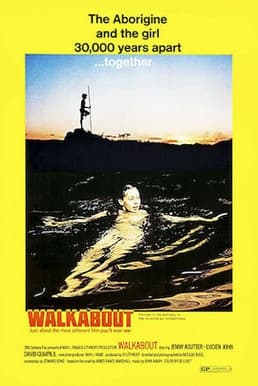
Walkabout is a British film about a country it never claims
Nicolas Roeg's 1971 picture is claimed as an Australian classic, though it was made by a Londoner, financed by two Americans and sold by 20th Century Fox. Its best argument is how little it pretends otherwise.
Rolf de Heer keeps handing the film to whoever gets left out
Across forty years Rolf de Heer never settled on a style, because his real signature was never visual; it was a decision about who gets to hold the camera.
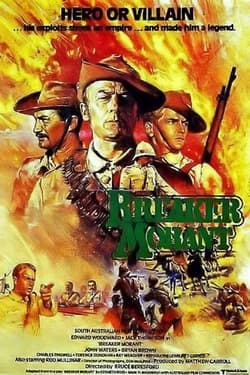
Breaker Morant and the country that adopted its scapegoat
Bruce Beresford's 1980 courtroom drama made an English-born soldier into an Australian martyr, and the picture's argument about empire has outlived its historical certainties.