Rewatching Lantana in lockdown and noticing what the neighbours hear
Ray Lawrence's film is about what happens when suburban walls are too thin, and in lockdown every wall became too thin.
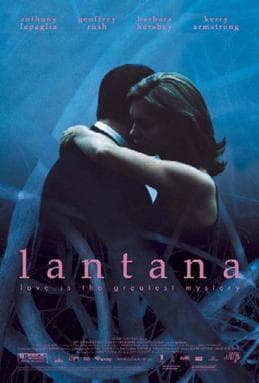
I had not watched Lantana in probably six years, which is too long for a film this good and too short for me to have forgotten the plot, so I went into it knowing what happens and thinking I knew what the film was about. It is about marriages. It is about secrets. It is about the specific way middle-aged Australians fail each other through silence and proximity and the inability to say the necessary thing at the necessary time. All of that is still true. But watching it in September 2020, six months into whatever this year has become, locked in my apartment for the second time with the stage four restrictions pressing down on Melbourne like a hand on a chest, what I noticed was something else entirely. I noticed the walls.
Ray Lawrence’s film is full of walls. Thin ones. The houses in Lantana are close together and the lives inside them bleed through. You hear your neighbour arguing. You see your neighbour’s car parked where it should not be. You know things about the people next door that you did not ask to know and cannot unknow, and this involuntary knowledge becomes the engine of the plot. Everyone in Lantana knows too much about everyone else, not because they are nosy but because the architecture of suburban Sydney will not let them look away.
Proximity as plot
The film opens with a body in the lantana, which tells you immediately that something has gone wrong, and then it spends two hours showing you how. The how is not dramatic in the way crime films usually are. Nobody pulls a gun or delivers a monologue about justice. The how is domestic. It is Anthony LaPaglia as Leon Zat, a detective whose marriage to Sonja (Kerry Armstrong) is collapsing in the quiet, grinding way that marriages collapse when neither person can say what is wrong. It is Geoffrey Rush as Patrick Phelps, a man whose grief over his dead daughter has turned inward and hardened into something his wife, Valerie (Barbara Hershey), can no longer reach. It is Vince Colosimo and Daniela Farinacci as a younger couple whose relationship serves as a counterpoint, still alive enough to be wounded, not yet calcified.
Lawrence lets these stories unfold at the speed of real domestic life, which is to say slowly, with long pauses and half-finished sentences and moments where the camera holds on a face that is deciding whether to speak. The film has the structural patience of a novel. It trusts you to track four couples without colour-coding them or spelling out the connections. It trusts you to sit in discomfort while Leon drives to his dance class and you know, and Sonja does not yet know, what is happening there.
What lockdown did to the film
I have been inside my apartment for weeks. I hear my neighbours more than I have ever heard them. I hear the couple upstairs arguing about something I cannot quite make out, just the rhythm of it, the rising and falling tones that tell me it is serious without telling me what it is about. I hear the woman next door on the phone to someone she loves, or loved, the conversation going in circles the way those conversations do. I hear doors closing with more force than necessary. I know things about these people that I did not ask to know.
Lantana landed differently this time because of this. In 2014 when I last watched it, the film’s interest in overheard intimacy felt like a thematic choice, a smart structural decision by Lawrence and screenwriter Andrew Bovell. In 2020 it feels like a documentary about my building. The walls are too thin. The proximity is inescapable. The knowledge accumulates whether you want it to or not.
Leon Zat, watching him this time, struck me as a man who cannot stand being known. His affair, his aggression, his refusal to talk to Sonja about anything that matters, all of it reads as a sustained attempt to maintain privacy inside a life that will not allow it. LaPaglia plays this without vanity. He lets Leon be unlikeable, lets the audience see the smallness of his choices without excusing them. It is one of the best performances in Australian film and it works partly because LaPaglia never asks you to sympathise. He just shows you the man, and the showing is enough.
The women who carry the weight
What I noticed this time, more than before, is how much of the film’s emotional labour falls on the women. Kerry Armstrong won the AFI for Sonja and she deserved it. The scene where she confronts Leon, where the whole structure of their deception collapses in a kitchen, is devastating not because of what is said but because of how long it took to get there. Armstrong plays the arrival of the truth not as a revelation but as a confirmation. Sonja knew. She knew and she waited and the waiting was its own kind of violence, done to herself, and when she finally speaks it is not anger but exhaustion that comes through. The fight is over before it begins because Sonja has already had it, alone, in her head, for months.
Barbara Hershey does something equally precise with Valerie. A woman whose professional life involves listening to other people’s pain and whose personal life is defined by a pain nobody can reach. Hershey plays the contradiction without resolving it. Valerie is competent and broken at the same time, capable in rooms where she is the therapist and lost in rooms where she is the wife, and the film never suggests these two states are contradictory. They coexist, the way they do in life, uncomfortably and without resolution.
The structural patience
Lawrence directed only three features in his career. Bliss in 1985, Lantana in 2001, Jindabyne in 2006. The gaps between them suggest a filmmaker who waited until the material was ready, or until he was ready, and the films reflect that patience. Lantana moves at the speed of its characters’ lives. Scenes end without punctuation. Conversations trail off into silence and the silence is allowed to sit there, on screen, doing its work.
This is the quality I value most in the film and the one that felt most relevant in lockdown. Time moves differently when you cannot leave your apartment. The days blur. The hours stretch. Small interactions carry enormous weight because they are the only interactions you have. Lantana understands this rhythm, the way tiny exchanges between people who live too close together accumulate into something that can break a marriage or solve a crime or both.
The lantana itself
The plant is a weed. It grows everywhere in Sydney, thick and tangled, and it hides things. The body in the opening shot is tangled in it, invisible from the road, concealed by something that everyone walks past without noticing. It is not a subtle metaphor, but Lawrence does not use it subtly. He uses it plainly, the way the film uses everything, without ornament, trusting the audience to see what is there.
I finished the film at eleven at night, alone in my apartment, and sat for a while in the quiet. Upstairs, the neighbours had stopped arguing. The woman next door was not on the phone. The building was holding its breath the way buildings do late at night when everyone is inside and awake and pretending not to hear each other.
Lantana is nineteen years old and it has not aged because the thing it is about has not changed. We live too close. We hear too much. We know things about each other that courtesy requires us to ignore and that proximity makes impossible to forget. In September 2020, locked in a building full of people I have never met but whose voices I know as well as my own family’s, the film felt less like a rewatch and more like a diagnosis.

Mara writes essays. She came to film writing from a decade of literary criticism and still reaches, sometimes, for a novel before she reaches for a shot list. She lives in the inner north of Melbourne and does not explain which city that is.
MORE BY MARA DENG →
Babyteeth and the dignity of falling apart in public
Shannon Murphy's debut refuses to tidy its grief, and the mess is exactly where the film finds its nerve.
Strictly Ballroom is a film about who is allowed to teach the steps
Baz Luhrmann's 1992 comedy is sold as a story about dance. It is also a story about an Australian champion who has to be taught his own steps by a Spanish-Australian family in their own house.

Looking for Alibrandi was the first Australian story handed to me as mine
It was not my family's story. It was the shape of my family's story, put on a screen in a country that had never once bothered to hold it before.