JobKeeper kept the screen industry alive and nobody wants to talk about what happens next
The subsidy is keeping crews on payroll, but the productions that would employ them are frozen, and the gap between the two is widening.
The numbers first. Per the latest ABS filing, roughly 32,000 people work in the Australian screen production sector if you count freelancers, which you must, because freelancers are the sector. Of those, somewhere between 8,000 and 12,000 are currently receiving JobKeeper payments. The range is wide because the ATO does not break the figures down by sub-industry, and because the line between “film crew” and “events crew” and “corporate video crew” is a line that mostly exists on grant applications.
What the filing shows is this: the money is flowing. $1,500 per fortnight per eligible worker, administered through employers or sole-trader ABNs, keeping thousands of gaffers and production coordinators and location scouts technically attached to companies that have not shot a frame since March.
The productions themselves are frozen. Screen Australia’s internal tracker listed 118 productions in some stage of development or pre-production when the shutdowns began. By late June, 94 of those had paused. Not cancelled. Paused. The distinction matters because “paused” means the intention to resume exists, which means the crew attached to those projects is in a holding pattern, collecting JobKeeper through their employer of record while waiting for a start date that nobody can confirm.
The gap nobody is measuring
The structural problem is straightforward. JobKeeper is a wage subsidy. It assumes the worker has a job to return to. In screen production, the job does not exist until the production exists, and the production does not exist until insurance, locations, and border exemptions are all confirmed simultaneously. As of this week, none of those three elements is reliably available in any state except the Northern Territory, which accounts for approximately two per cent of total Australian production activity.
So the subsidy is keeping people on payroll at companies that have no work. This is not fraud. It is the design of the programme. But it creates a false stability. The crew member collecting $1,500 a fortnight is, on paper, employed. In practice, they have not worked since mid-March, their skills are perishable, and their industry is not recovering at the rate the Treasury forecasts assume.
Screen Producers Australia surveyed its members in June. The results were not encouraging. Sixty-one per cent of respondents said they had no confirmed production start date for the remainder of 2020. Forty-three per cent said they expected to lose at least one key crew member permanently to another industry before work resumed. The most common destination cited was construction, which is both hiring and paying more.
What happens in September
The original JobKeeper programme ends on 27 September. The government has announced a six-month extension, but at reduced rates: $1,200 per fortnight from October to December, then $1,000 per fortnight from January to March 2021. The eligibility test tightens too. Businesses will need to demonstrate ongoing revenue decline relative to a comparable period, and for production companies whose revenue is inherently lumpy, proving a quarterly drop against a quarter where you happened to deliver a feature is not difficult. Proving it against a quiet quarter is.
The industry bodies are preparing their submissions. Screen Producers Australia wants the decline test modified for project-based businesses. The Media, Entertainment and Arts Alliance wants an extension of the full $1,500 rate for industries where social distancing rules make the work itself impossible, not merely inconvenient. Both requests are reasonable. Neither is likely to be granted in full.
The freelancer problem
Buried in the figures is a secondary crisis. JobKeeper was available to sole traders and the self-employed, which covered a portion of the freelance crew base. But it required an ABN active before 12 March 2020 and evidence of business income in the 2018-19 financial year. A significant number of early-career crew members, particularly in camera and post-production departments, did not meet both criteria. They fell through the gap into JobSeeker, which paid less and came with mutual obligation requirements that assumed the recipient was actively looking for work in an industry where no work existed.
Per the MEAA’s figures, approximately 2,400 screen-industry workers ended up on JobSeeker rather than JobKeeper. These are disproportionately young, disproportionately casual, and disproportionately likely to leave the industry permanently. The union is calling this a generational talent loss. The government is not calling it anything, because officially it is not happening.
What the spreadsheet does not show
The financial architecture is doing what financial architecture does: keeping the numbers stable while the reality underneath shifts. Crews are on payroll. Companies are solvent. The ABS will record employment in the screen sector as broadly unchanged through the June quarter. And when productions resume, whenever that is, the people who answer the phone may not be the same people who were there before. Some will have found other work. Some will have left Sydney and Melbourne for regional towns where the rent is lower. Some will have simply stopped identifying as screen workers, the way you stop identifying as anything when the thing you do ceases to be available to you.
The subsidy kept the industry alive. That is true. The question nobody is answering is what shape it will be in when it wakes up.

Odette covers the business of Australian screen. Previously a financial journalist. Reads every Screen Australia annual report the week it drops. Short paragraphs, long memory, never misses a figure.
MORE BY ODETTE MALOUF →
JobKeeper ended and the screen industry is counting who is left
The subsidy ran out in March, and the freelance crew base that built Australian film is thinner than it was twelve months ago.
The Australian screen industry enters 2026 with fewer commissions and more questions
Total commissions are down 22 per cent on the 2023 peak, and the local content quota has not yet made up the difference.
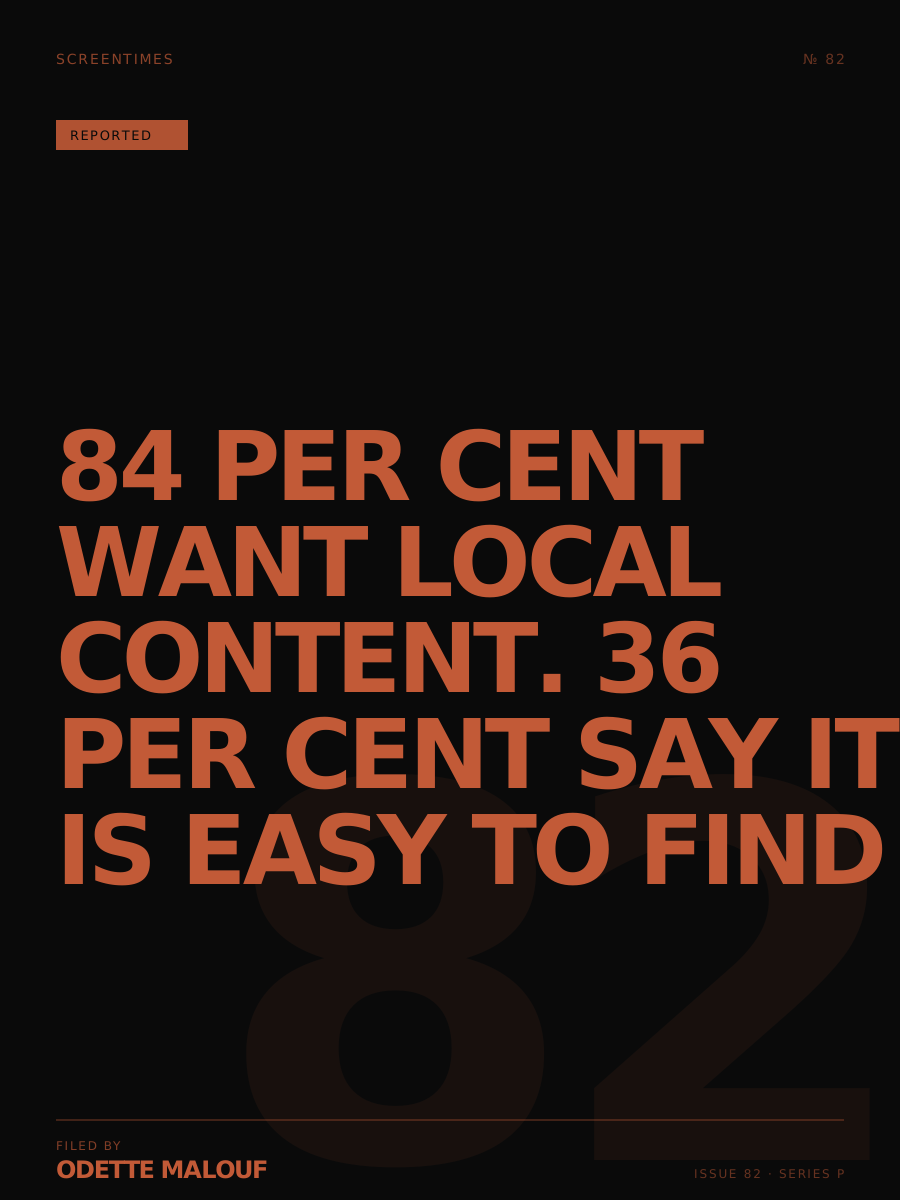
84 per cent want local content. 36 per cent say it is easy to find
Screen Australia's Screen Currency 2026 report finds strong demand for Australian screen stories and a discovery problem that no amount of production funding fixes on its own.