How to Please a Woman asks a question Australian cinema rarely allows its women to answer
Renée Webster built a sex comedy about middle-aged women in Fremantle and treated the premise with more seriousness than the genre usually permits.

Gina (Sally Phillips) is turning fifty. She has a husband who is not unkind, a house in Fremantle that is clean and well-maintained, a group of friends who meet regularly for ocean swims, and a body she has stopped thinking of as something that might want things. She is not unhappy. She is something more common and harder to dramatise: she is fine. The fineness is total. It covers everything. It is also, the film gradually reveals, a form of anaesthesia, and the question How to Please a Woman asks is what happens when the numbness lifts and a woman who has been fine for decades discovers that fine was never enough.
How to Please a Woman (Renee Webster, 2022) has a premise that sounds like a pitch meeting punchline: a middle-aged woman starts an all-male cleaning business, discovers her clients want more than clean houses, and pivots the business model accordingly. The premise invites a certain kind of film, broad and winking and reassuring, the kind of comedy where female desire is acknowledged only to be domesticated, where the joke is always that women wanting sex is inherently funny. Webster’s film is not that film. It uses the premise as a delivery mechanism for something more specific and less comfortable: an examination of what happens to female pleasure when an entire culture has spent decades telling women that their desires are secondary, embarrassing, or irrelevant.
This is not to say the film is grim. It is frequently funny, and the comedy is not incidental to the argument but central to it. Webster understands that laughter is the sound women make when they recognise something true that they have been pretending is not true, and the film’s best jokes work on that principle. When Gina’s friends, one by one, begin using the service and then begin talking about it, the conversations have the giddy, conspiratorial energy of women sharing information that the world has told them they should not need.
The Fremantle of it
The setting matters. Fremantle is not Sydney or Melbourne, where stories about women and desire might be absorbed into a broader cosmopolitan narrative. Fremantle is a port town with a specific social texture: middle-class but not wealthy, progressive in attitude but conservative in habit, the kind of place where people know each other’s business and form opinions about it. Gina’s decision to start the business is not anonymous. It happens in a community where reputation is currency and where a woman who sells sexual services to other women, even when those services are performed by consenting adult men, is stepping outside the bounds of what the community considers acceptable.
Webster shoots Fremantle with an affection that does not preclude criticism. The ocean swims, which bookend the film and punctuate its middle, are filmed with a warmth that makes the water look like a communal space, a place where women’s bodies exist without judgement. The houses are neat and sunlit and slightly too tidy, as if their owners have been maintaining surfaces for so long that they have forgotten about depth. The town itself becomes an argument about visibility: Gina’s business forces private desires into public space, and the discomfort this produces is not just personal but geographic. Fremantle is too small for secrets, which means Gina’s revolution, if that is what it is, cannot happen quietly.
Phillips and the comedy of wanting
Sally Phillips, best known in Australia for the Bridget Jones films and Veep, brings to Gina a quality that is harder to achieve than it looks: she makes wanting look normal. This sounds like a low bar, but in the context of how cinema typically represents middle-aged female desire, it is not. The standard approach is either comedy, where the desire is the joke, or melodrama, where the desire is the crisis. Phillips does neither. She plays Gina as a woman who is surprised by her own appetites, not because wanting is surprising but because she had forgotten she was capable of it. The surprise is not comic. It is the recognition of something that was always there, buried under years of accommodation and compromise and the particular exhaustion of being a woman who has spent her adult life attending to other people’s needs.
There is a scene early in the film where Gina receives a massage from one of her employees, and the scene could easily have been played for titillation or awkwardness. Phillips plays it for something else: the physical shock of being touched with attention. Her face registers not pleasure exactly but the memory of pleasure, the body recalling a capacity that the mind had filed away. It is a small moment, and Phillips does not oversell it, and it establishes the emotional stakes of the film more effectively than any line of dialogue.
The men in the room
The male characters in How to Please a Woman are drawn with more care than the premise might suggest. The cleaners-turned-lovers are not beefcake cutouts; they are working men with their own economic pressures and their own relationships to masculinity, and the film is interested in how the business model affects them as well as the women. Tom (Alexander England), who becomes Gina’s primary love interest, is given enough interior life that his arc does not reduce to “man who services women.” He has his own ambivalence about the work, his own pride, his own desire to be seen as more than a body, and the film draws a quiet parallel between his position and Gina’s: both are people whose physical selves have been instrumentalised by a culture that prefers them functional rather than feeling.
Webster also handles Gina’s husband, Adrian (Cameron Daddo), with a generosity that lesser films would not bother with. Adrian is not a villain. He is a man who has been adequate for twenty years and cannot understand why adequacy is no longer enough. His confusion is genuine, and the film does not punish him for it, though it does not let him off the hook either. The marriage does not end in cruelty or betrayal. It ends in the quieter catastrophe of two people realising they have been performing contentment rather than experiencing it, and that the performance has cost them both.
The Dressmaker comparison
It is worth placing How to Please a Woman alongside The Dressmaker (Jocelyn Moorhouse, 2015), another Australian film about a woman who disrupts a small community by offering something the community did not know it wanted. Tilly Dunnage (Kate Winslet) returned to her hometown with haute couture; Gina offers something more fundamental but equally transgressive. Both films use a female protagonist’s professional skill as a mechanism for exposing the hypocrisies of a community that prefers its women useful but unthreatening. Both films allow their heroines to be funny and furious at the same time, which is a combination that Australian cinema, for all its strengths, does not always permit.
The difference is tonal. The Dressmaker escalated into gothic revenge fantasy, burning the town down, literally, as a final act of liberation. How to Please a Woman stays grounded. Gina’s revolution is domestic rather than apocalyptic. She does not destroy the town. She changes it, incrementally, by forcing a series of private conversations that the town’s women were not having with their partners, with each other, or with themselves. The scale is smaller. The stakes feel larger, because they are the stakes of actual life: whether a woman in her fifties can renegotiate the terms of her own existence without blowing everything up in the process.
What the film asks
The question in the title is not rhetorical, and the film is honest enough to admit that it does not have a single answer. What pleases a woman turns out to be as various and specific as the women themselves, which is both the film’s thesis and its structural challenge. Webster manages the ensemble by giving each of Gina’s friends a distinct relationship to the central question: one wants physical contact she is not getting at home, another wants the feeling of being prioritised, another wants permission to want at all. The variety is the point. These are not women with a shared problem. They are women with a shared silence, and the business gives them a vocabulary they did not previously have.
This is what How to Please a Woman does best. It takes a premise that could have been disposable and makes it serious without making it heavy, funny without making it trivial, and specific without making it narrow. The film is not perfect. Some of the secondary storylines feel undercooked, and the final act resolves too neatly for a film that has been so honest about the messiness of desire. But it asks its question plainly and without embarrassment, and it trusts its audience, especially its female audience, to recognise the question as one they have been living with for longer than they might care to admit.

Bronte writes long-form criticism of Australian cinema and the international art films that feed into it. She was on the ground at Cannes in 2019 and has not entirely forgiven the festival for 2020. Patient with slow films; impatient with tidy ones.
MORE BY BRONTE HAUGHEY →
Seriously Red puts a real estate agent in rhinestones and dares you to care
Gracie Otto's debut puts a real estate agent in a rhinestone jumpsuit and dares the audience to take both the costume and the sadness underneath it seriously.

Breaker Morant and the country that adopted its scapegoat
Bruce Beresford's 1980 courtroom drama made an English-born soldier into an Australian martyr, and the picture's argument about empire has outlived its historical certainties.
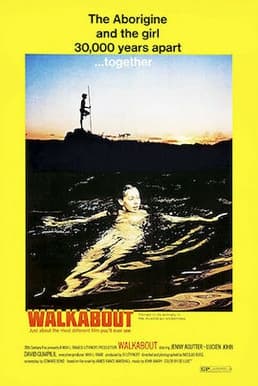
Walkabout is a British film about a country it never claims
Nicolas Roeg's 1971 picture is claimed as an Australian classic, though it was made by a Londoner, financed by two Americans and sold by 20th Century Fox. Its best argument is how little it pretends otherwise.