Gold buries Zac Efron in the desert and dares you to watch him dig
Anthony Hayes stripped the survival genre to one man, one hole, and ninety minutes of sun, and the restraint holds.
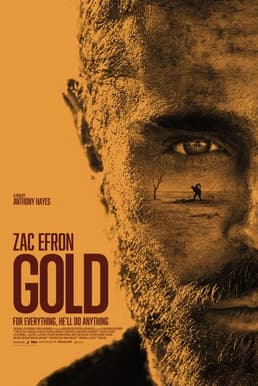
The premise of Gold can be stated in a sentence, and Anthony Hayes would probably prefer it that way. Two men travelling through a desert find a gold nugget too large to carry. One stays to guard it while the other goes for help. The one who stays begins to lose his mind. That is the film. There is no subplot about a family back home, no radio crackling with rescue updates, no flashback structure to break the monotony of watching a man sit in dirt. Hayes wrote the screenplay with Polly Smyth, directed the picture, and cast himself as the man who leaves, which means he gave himself the role that disappears from the film after twenty minutes and handed the remaining seventy to Zac Efron. It was a generous decision and, as it turned out, a correct one.
Efron is alone on screen for the vast majority of the running time, and the performance he delivers is built almost entirely from physical deterioration. His skin blisters. His lips crack. His body curls into itself as dehydration takes hold. The transformation is not the kind that wins awards in the traditional sense, because it is not a transformation into someone else. It is a subtraction. Efron does not become a character so much as he becomes a body in a landscape, a human organism responding to heat and thirst and the slow erosion of rational thought. The vanity that has defined his public image since High School Musical is not just absent; it is actively dismantled, shot by shot, as the desert strips away every layer of composure.
The desert as antagonist
The location is unspecified. The film refuses to name a country, a continent, or a time period, which is either a bold act of abstraction or a commercial hedge, depending on your generosity. The landscape reads as Australian to anyone who has spent time in the interior, the colour of the soil, the quality of the light, the particular flatness of a horizon that offers no shade and no landmark and no reason to believe that walking in any direction will lead to anything different from what is already here. Hayes shot the film in South Australia, and the production design strips the setting of every identifying marker except the ground itself.
This is the film’s central formal commitment: the desert is not a backdrop but an antagonist, and it is a more effective one than any human villain could have been. The sun does not relent. The wind shifts the sand over the nugget, threatening to bury the thing that is the only reason to stay. Insects arrive. A dog arrives, and the question of whether it is real or hallucinated is left open long enough to become uncomfortable. Hayes and his cinematographer, Ross Giardina, shoot the desert in wide frames that emphasise Efron’s smallness and in close-ups that emphasise the texture of his collapse. The two scales work against each other, and the tension between them is where the film finds its rhythm.
The economy of less
There is a tradition of Australian survival cinema that Gold belongs to, even as it refuses to announce the connection. John Curran’s Tracks (2013) sent Mia Wasikowska across 2,700 kilometres of Western Australian desert with four camels and a dog, and that film’s power came from the accumulation of landscape, the way the desert changed as Wasikowska moved through it and the way she changed with it. Ben Howling and Yolanda Ramke’s Cargo (2017) used the Australian outback as the setting for a zombie film and found something unexpected in the combination: the emptiness of the landscape, which in a survival film represents danger, became in a zombie film a kind of sanctuary, the one place where the infection had not yet reached.
Gold takes a more radical position than either. It removes movement from the equation entirely. Efron does not walk anywhere. He does not have a destination. He sits in a hole he has dug around a rock, and the film sits with him. This stasis is the point, and it is also the risk, because a film about a man who does not move has to find its momentum elsewhere. Hayes locates it in the body: in the incremental physical decline, in the small decisions about water rationing and shelter construction that become the film’s entire dramatic vocabulary. A scene in which Efron fashions a shade structure from his clothing is given the weight and the pacing of a set piece, and it earns the treatment, because within the logic of the film, keeping the sun off his head for three hours is as consequential as any car chase.
Why the casting works
The decision to cast Efron was criticised in some quarters before the film’s release, on the grounds that his celebrity would distract from the minimalism. The opposite turned out to be true. Efron’s fame is inseparable from a specific kind of American physical perfection, the tanned symmetry of a man who has been photographed shirtless on magazine covers for the better part of fifteen years. Putting that body in a context where it is systematically destroyed creates a friction that a less famous actor could not have generated. You watch Efron deteriorate and some part of your brain keeps cross-referencing the image against the version of him you already know, the one from the comedies and the Netflix travel show and the paparazzi shots. The gap between those two Efrons is where the film does its most interesting work.
The limits of minimalism
The picture is not without problems. The dream sequences are its weakest element, reaching for a psychological depth that the rest of the film has wisely avoided. When Hayes allows the desert to do the work, the film is precise and disciplined. When he reaches for surrealism, the precision slips, and you become aware of the screenplay’s construction in a way that the best survival films do not allow. There is a sequence involving another traveller that introduces a human threat, and while it serves the plot, it feels like a concession to an audience that might not tolerate another thirty minutes of a man alone with a rock.
These are minor complaints in the context of what Hayes has achieved. Gold is a film that bets everything on restraint, and the restraint holds. It does not try to be a parable about greed, though the raw material is there. It does not try to be a commentary on masculinity, though Efron’s physical collapse could support that reading. It is, at its most fundamental level, a film about what happens to a human body when you leave it in the sun for too long, and the horror of that is sufficient. The desert does not care about the gold. The desert does not care about anything. That indifference is the most frightening thing in the film, and Hayes was smart enough to let it be.
Bronte writes long-form criticism of Australian cinema and the international art films that feed into it. She was on the ground at Cannes in 2019 and has not entirely forgiven the festival for 2020. Patient with slow films; impatient with tidy ones.
MORE BY BRONTE HAUGHEY →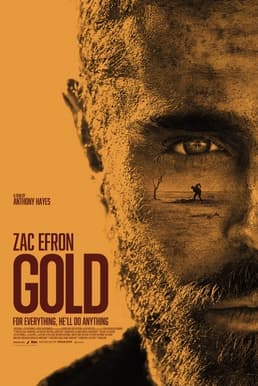
The score for Gold keeps one note going until the desert swallows it
The scoring challenge is simple: one man, one hole, one piece of gold, and ninety minutes of waiting for something to go wrong.
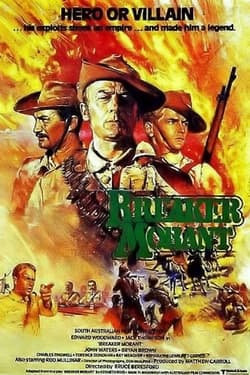
Breaker Morant and the country that adopted its scapegoat
Bruce Beresford's 1980 courtroom drama made an English-born soldier into an Australian martyr, and the picture's argument about empire has outlived its historical certainties.
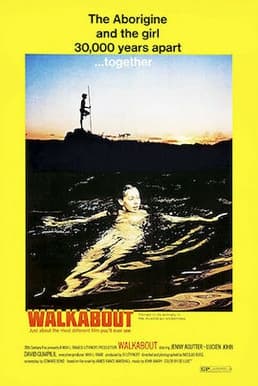
Walkabout is a British film about a country it never claims
Nicolas Roeg's 1971 picture is claimed as an Australian classic, though it was made by a Londoner, financed by two Americans and sold by 20th Century Fox. Its best argument is how little it pretends otherwise.