The Australian western keeps returning to the frontier because the frontier never left
From The Proposition to Sweet Country to The Nightingale, the Australian western is not a costume drama; it is a reckoning conducted on horseback.
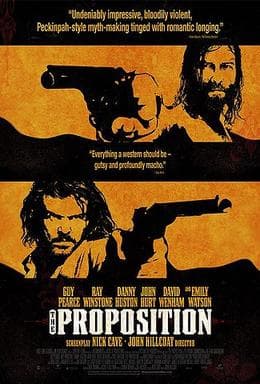
There is a scene in The Proposition where the sun sets behind a homestead and the sky goes the colour of a wound. Not red exactly, not orange, but something between the two that has no name in English, though I suspect it has one in the language of whoever lived on that country before the homestead was built. I watched it on a projector in a friend’s living room in Brunswick, years after its release, and when that sky filled the wall I had the feeling I sometimes get in galleries when a painting is hung too low and you walk into it before you are ready. The film was not showing me a sunset. It was showing me what a sunset looks like when people are dying underneath it.
I want to say something careful here, because the Australian western is a genre that invites carelessness. It invites you to admire the landscape, to feel the dust, to notice the hats and the horses and the period-correct rifles, and to mistake all of that texture for meaning. What I mean is: the clothes are not the point. The horses are not the point. The frontier is the point, and the frontier is not a place. It is an argument. It is the line that colonial Australia drew between itself and the country it was standing on, and every Australian western is, in one way or another, a film about that line.
Five films, five ways to cross the line
The Tracker came first, in 2002, and Rolf de Heer did something I am still thinking about. He cast David Gulpilil as an Aboriginal tracker forced to guide a white police party through the bush in pursuit of an Aboriginal man accused of murdering a white woman. The tracker is smarter than everyone in the party. He knows this. They know this. The film knows this. And yet the power runs one way, because the men with badges and guns have decided it does, and the tracker’s intelligence is, within the logic of the colony, irrelevant.
De Heer uses painted panels instead of filming the violence directly. When the worst things happen, the camera cuts to a still image, a painting of the act, and the effect is not distance but compression. The violence is so embedded in the structure of the colony that it has already become iconography. It is already a painting before the paint is dry.
Three years later, John Hillcoat and Nick Cave made The Proposition, which is the one most people think of when you say “Australian western,” and fair enough. It is extraordinary. Guy Pearce, dirty and desperate, is given an impossible choice: kill his older brother (Danny Huston) or his younger brother hangs. The outback is a furnace. The flies are relentless. Emily Watson sits in a homestead surrounded by a white picket fence and a rose garden, and the fence is the most violent image in the film, because it says: this is where civilisation ends and that begins. Except the violence is on both sides of the fence. The violence built the fence.
What Cave’s screenplay understands, and what Hillcoat’s direction honours, is that the proposition itself is the shape of colonialism. A white authority offers a white outlaw an impossible transaction, and the terms are set by who has the power to set terms. Aboriginal people are present in the film, sometimes centrally, sometimes at the margins, but always as the ground on which the transaction is conducted. The land, the original inhabitants of the land, and the question of who gets to dispense justice on that land: these are not subtext. They are the text.
Guilt does not expire
I skipped ahead to 2018, which gave us two films that I cannot think about separately, even though they are very different. Warwick Thornton’s Sweet Country and Jennifer Kent’s The Nightingale arrived in the same year like two witnesses giving testimony about the same crime from different positions in the room.
Sweet Country is set in the 1920s Northern Territory. Sam Kelly, an Aboriginal stockman played by Hamilton Morris, kills a white man in self-defence and flees into country with his wife. A posse pursues. The structure is a western, unmistakably, but Thornton does something with time that westerns rarely do: he fractures it. Flash-forwards interrupt the chase. The future bleeds into the present. What this means, and I think Thornton is very deliberate about it, is that the events of the 1920s are not contained in the 1920s. They are still happening. The chase has not ended. The verdict has not been reached.
Thornton is Kaytetye, from Alice Springs, and his camera looks at the landscape with a knowledge that none of the other directors on this list can replicate. The land in Sweet Country is not hostile and not indifferent. It is home. It is Sam’s home. The posse riding across it are the intruders, and Thornton’s framing makes this clear without ever stating it, which is more effective than stating it would be.
The Nightingale is set in Van Diemen’s Land in 1825. Clare, an Irish convict played by Aisling Franciosi, is brutalised by a British officer and pursues him through the Tasmanian bush with an Aboriginal tracker, Billy, played by Baykali Ganambarr. Kent does not flinch. The violence in this film is appalling, and it is appalling because it is specific: not stylised, not metaphorical, not the kind of violence that lets you admire the choreography. It is the violence of empire applied to bodies, and you sit in it, and it does not let you leave.
What interests me about The Nightingale is the relationship between Clare and Billy. They do not like each other at first. They are both, in different ways, victims of the same system, but their suffering is not equivalent and Kent does not pretend it is. Clare’s dispossession as an Irish woman under British rule is real. Billy’s dispossession as a palawa man on his own country is something else entirely. The film holds both truths without collapsing them into each other, and this is harder than it sounds.
The latest crossing
Stephen Johnson’s High Ground in 2020 covers some of the same territory. A massacre in the Top End. A young Aboriginal man, Gutjuk (Jacob Junior Nayinggul), caught between his grandfather’s resistance and a white sniper’s guilt (Simon Baker, again drawn to the outback, again standing in country and reckoning with what his presence means). The film is less controlled than The Proposition or Sweet Country, and there are moments where the plot machinery creaks. But it does one thing that none of the others quite manage: it centres an Aboriginal character’s perspective for the entire runtime. Gutjuk is not a tracker or a supporting figure or a moral lesson for a white protagonist. He is the protagonist. His choices are the choices that matter.
I keep being asked why Australian cinema returns to the western. The question assumes the genre is historical, that we dress up in period costume and ride horses because we want to understand something about the past. But the Australian western is not about the past. It is about the present wearing the past’s clothes. The frontier that these films keep crossing, the line between colonial order and the country it displaced, has not moved. It has been surveyed and legislated and renamed, but it has not moved.
Where the line falls now
The gap in life expectancy. The incarceration rates. The land rights negotiations that drag across decades while mining leases are approved in months. The frontier is a planning document, a parliamentary question, a postcode. It is not on horseback any more, but it is not gone.
What the Australian western does, at its best, is refuse the comfort of distance. It puts you on a horse in 1880 or 1920 and then it cuts forward, or it holds the shot long enough that the period detail falls away and you are left with the structure underneath: who has power, who does not, and what happens on the ground where those two things meet.
I watched The Proposition again a week ago. The sky still went the colour of a wound. The fence was still there. The flies were still relentless. And the frontier, which was supposed to be a line on a map from two centuries ago, was still exactly where it has always been. Right here. Under my feet. Under all of ours.

Mara writes essays. She came to film writing from a decade of literary criticism and still reaches, sometimes, for a novel before she reaches for a shot list. She lives in the inner north of Melbourne and does not explain which city that is.
MORE BY MARA DENG →
Australian horror found its voice by refusing to be polite
From The Babadook to Relic to Talk to Me, Australian horror keeps returning to the house, the family, and the thing that should not be let in.
Strictly Ballroom is a film about who is allowed to teach the steps
Baz Luhrmann's 1992 comedy is sold as a story about dance. It is also a story about an Australian champion who has to be taught his own steps by a Spanish-Australian family in their own house.

Looking for Alibrandi was the first Australian story handed to me as mine
It was not my family's story. It was the shape of my family's story, put on a screen in a country that had never once bothered to hold it before.