Sydney Film Festival is a room full of strangers agreeing to sit still together
The festival is not really about the films; it is about the decision to be in a room with other people who chose to be there too.
The State Theatre on Market Street has a ceiling that looks like it was designed by someone who wanted you to forget you were in Sydney. It is painted with stars and clouds and ornamental plasterwork that belongs to a European opera house, not a building wedged between fast food outlets and office towers on a street that smells like bus exhaust. Every June, the Sydney Film Festival takes over this theatre and a handful of smaller venues, and for about twelve days the city pretends it is the kind of place that prioritises cinema. It is a pleasant fiction. I go along with it every year.
SFF 2023 ran from 7 to 18 June. I attended nine sessions across six days, which is fewer than I planned and more than my knees appreciated. The State Theatre seats are beautiful and punishing. They were designed for an era when people were smaller and less likely to complain. By day three I had developed a specific pain in my lower back that I associate exclusively with festival-going, a discomfort that functions as proof of commitment.
I want to talk about the films, and I will, but the films are not really what I want to talk about. What I want to talk about is the experience of being in a room with four hundred strangers who have all made the same odd decision: to leave their houses, travel to a theatre, sit in the dark, and watch something they know almost nothing about. This is the core transaction of a film festival. You are not choosing a film. You are choosing to trust the programme.
The conversations you do not plan
The best part of SFF is not the screenings. It is the fifteen minutes after a screening, when you are standing in the foyer or on the footpath outside and someone near you says something about what you both just watched, and a conversation starts that would not happen in any other context. These are not your friends. You do not know their names. You will probably never see them again. But for a few minutes you are two people who watched the same thing and want to process it out loud.
After a screening of Omen (Baloji, 2023), a Congolese-Belgian film about witchcraft accusations, I stood on Market Street and talked to a woman in her sixties about colonial Christianity for twenty minutes. Neither of us introduced ourselves. The conversation ended when she said she had to catch a bus. I think about that exchange more than I think about most of the films.
This is what streaming cannot replicate. Not the big screen, not the sound system, not the projection quality, though all of those matter. What streaming cannot replicate is the stranger on the footpath who has just been shaken by the same thing that shook you and wants to say so.
How SFF is not MIFF
People ask me how Sydney Film Festival compares to Melbourne International Film Festival, and I have a stock answer that I think is mostly true: Sydney is more curated, Melbourne is more comprehensive. MIFF, which runs in August, programmes hundreds of films across multiple venues and has the feeling of a city that has absorbed cinema into its metabolism. Melbourne has always been a film city. It has the density, the laneway culture, the population of people who describe themselves as being interested in film. MIFF feels like Melbourne expressing itself.
SFF feels more like an argument. The programme is smaller and the selections feel more deliberate. Nashen Moodley, the festival director through 2023, built programmes that had a point of view. You could see the connections between films, the conversations the programme was having with itself. This made SFF feel less like a marketplace and more like a reading list assembled by someone with specific concerns.
The venues matter too. MIFF uses the Forum, ACMI, and a network of cinemas across the city. SFF is anchored to the State Theatre, which gives it a centre of gravity that MIFF deliberately avoids. Walking into the State Theatre for an opening or closing night is a particular experience. The theatre is enormous and absurdly decorated and it makes you feel like cinema is an event, not a habit. MIFF makes cinema feel like weather, something that is always happening somewhere in the city. SFF makes it feel like a gathering.
The 2023 programme
I should mention the films. The opening night film was The New Boy (Warwick Thornton, 2023), which I think is one of the most visually striking Australian films of the decade. Thornton, who also served as his own cinematographer, made a film about a young Aboriginal boy brought to a remote monastery in the 1940s, and every frame looks like a painting in which the light is doing theology. Cate Blanchett plays a nun running the monastery, and her performance has the quality of a person holding something together by refusing to examine what is falling apart.
I saw Monster (Hirokazu Kore-eda, 2023), which restructures a story about a schoolboy in crisis through three different perspectives. Kore-eda is a filmmaker I follow from festival to festival, and Monster is one of his most structurally ambitious works. The audience around me was silent for the final twenty minutes in a way that I could feel physically, the particular silence of a room full of people who are holding their breath.
I saw How to Have Sex (Molly Manning Walker, 2023), a debut about British teenagers on a party holiday that builds slowly towards something awful and then refuses to let you look away from the aftermath. It was the most uncomfortable screening I attended, and the foyer conversation afterwards was the longest.
Why I keep going
You can stream most of these films. The New Boy was in cinemas weeks later. Monster arrived on platforms. The festival is not giving you access to films you cannot otherwise see. It is giving you access to an experience you cannot otherwise have: the experience of watching with intention, in a room full of people who are also watching with intention.
There is something about the act of choosing to attend a festival session that changes how you watch. You have looked at a programme, picked a time slot, bought a ticket, travelled to a venue, found your seat. You have committed. And in that commitment there is a quality of attention that is different from what happens when you scroll through a streaming library at nine o’clock on a Tuesday and press play on whatever looks least demanding.
I am not making an argument against streaming. I stream constantly. I watch films on my laptop in bed with headphones and I do not feel guilty about it. But the festival does something that my laptop cannot do. It puts me in a room with strangers and asks all of us to pay attention to the same thing at the same time, and in that shared attention there is a kind of community that does not require anyone to speak or introduce themselves or agree. You just have to sit still together.
The 70th Sydney Film Festival will have happened and the films will be available elsewhere and the conversations on Market Street will be forgotten by everyone except the people who had them. The State Theatre ceiling will still look like a European fantasy imposed on a city that does not need one. And next June I will go back, because the festival is not about the films. It is about the decision to be there, and the strange comfort of knowing that four hundred other people made the same decision, for reasons they could not entirely explain, on a cold night in a city that has plenty of other things to do.

Mara writes essays. She came to film writing from a decade of literary criticism and still reaches, sometimes, for a novel before she reaches for a shot list. She lives in the inner north of Melbourne and does not explain which city that is.
MORE BY MARA DENG →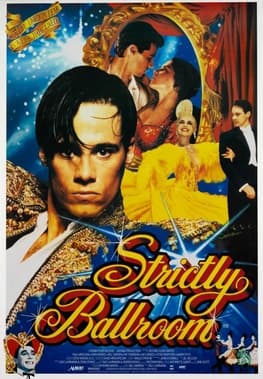
Strictly Ballroom is a film about who is allowed to teach the steps
Baz Luhrmann's 1992 comedy is sold as a story about dance. It is also a story about an Australian champion who has to be taught his own steps by a Spanish-Australian family in their own house.

Looking for Alibrandi was the first Australian story handed to me as mine
It was not my family's story. It was the shape of my family's story, put on a screen in a country that had never once bothered to hold it before.
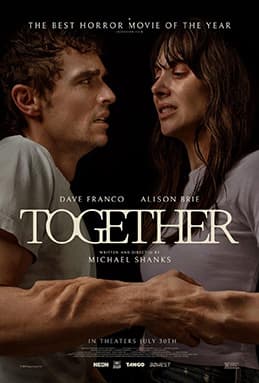
Together is an Australian horror film that learned to say trunk
Michael Shanks made a Melbourne body horror film about two people fusing into one, then sanded the Australian out of it. I keep looking for the seam.