The Royal Hotel fills a pub with men and dares you to name which one is dangerous
Kitty Green puts two backpackers behind an outback bar and lets the threat accumulate like bar tabs nobody plans to settle.
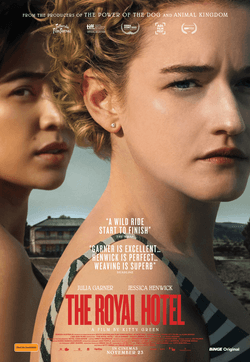
The picture begins with a familiar arrangement. Two young women arrive in a place they do not know, take a job they do not want, and find themselves surrounded by men who feel entitled to their attention. You have seen this before. You think you know what comes next. Kitty Green is counting on that assumption, because the entire architecture of The Royal Hotel depends on your genre instincts being slightly, persistently wrong.
Hanna (Julia Garner) and Liv (Jessica Henwick) are backpackers working behind the bar of a remote pub in outback New South Wales. The pub is real in the way that only Australian country pubs are real: the carpet is sticky, the light is flat, the men arrive at opening and stay past closing and the line between friendliness and intrusion has been rubbed away by decades of repetition. Green films this workplace with the same procedural attention she brought to The Assistant, her 2019 study of a junior employee navigating a predatory film executive’s office. The method is the same. The setting has changed, but the question has not: how do you identify danger when the entire environment has been calibrated to make danger look ordinary?
The register of threat
What Green does with the men in this pub is more unsettling than any single act of violence could be. There are perhaps a dozen regulars, and each one occupies a slightly different position on a spectrum that runs from harmless to alarming, with a wide band of ambiguity in the middle. Dolly (Hugo Weaving), the pub’s owner, is loud and inappropriate but also, in certain lights, simply a man who has been alone too long and has forgotten how to moderate himself. Billy (Daniel Henshall) lingers at the bar with a quietness that could be shyness or could be something else entirely. The younger men treat Hanna and Liv with a casual sexual entitlement that never quite crosses into threat but never quite retreats from it either.
Green does not give you the villain. She gives you the conditions in which a villain would be unremarkable. This is the register of the picture, and it is a difficult register to sustain because it requires the audience to sit inside discomfort without the relief of certainty. A conventional thriller would signal which man is the threat early on, through music cues or framing or behavioural tells, and then build toward a confrontation. The Royal Hotel refuses this. Every man at the bar could be the one who crosses the line, or none of them could, and the film insists that the distinction matters less than the fact that Hanna and Liv cannot tell.
The pub as workplace
There is a tendency in films set in remote Australia to treat the landscape as the source of menace. The outback is vast and indifferent and the isolation itself becomes the antagonist. Green is not interested in this reading. She shoots the pub interior with more attention than the surrounding desert, and the pub is not a set piece or a metaphor. It is a workplace. Hanna and Liv pull beers, clean glasses, manage the till, deflect comments. The rhythm of their shifts structures the film the way office hours structured The Assistant. Green understands that workplaces are where power dynamics are most visible and most normalised; the pub simply makes the dynamics louder because alcohol removes whatever thin courtesy might otherwise contain them.
Garner plays Hanna with a stillness that functions as both characterisation and survival strategy. She watches. She calculates. She does not laugh at jokes she does not find funny, which sounds like a small thing until you notice how much social labour Liv (Henwick, more openly accommodating) performs to keep the atmosphere manageable. The division between the two women is not a disagreement about values. It is a disagreement about tactics. Liv believes that friendliness purchases safety. Hanna suspects it purchases nothing at all.
Green’s consistent subject
If you place The Royal Hotel next to The Assistant, the continuity is striking. Both films are about women working inside systems that are not designed around their safety. Both refuse to provide a climactic confrontation that would allow the audience to discharge its anxiety. Both are interested in the accumulation of small violations rather than the drama of large ones. In The Assistant, the predator is never shown on screen; his presence is felt through the behaviour of the people around him, the way the office bends toward his gravity. In The Royal Hotel, the threat is distributed across the entire room, and the question is not who is dangerous but why the room itself has been arranged to make the question unanswerable.
This is Green’s subject, and it is a subject that resists the shapes that cinema finds most comfortable. Cinema wants identification. It wants you to know who the threat is so that you can fear them properly, and then it wants a resolution that either punishes the threat or punishes the victim or, in the prestige version, leaves things ambiguous in a way that still feels shaped. Green is after something flatter and more persistent. She wants you to feel what it is like to be inside a situation where the threat is systemic rather than individual, where no single person needs to do anything dramatic for the environment to remain hostile.
What the audience wanted and what the film gave
I have read reviews that describe The Royal Hotel as slow, or thin, or insufficiently eventful. These are accurate descriptions of the film’s surface. What the reviews sometimes miss is that the surface is the argument. Green is making a case that menace does not require event. It requires proximity, repetition, and the absence of any mechanism for complaint. Hanna cannot report the men at the bar to anyone because they have not technically done anything. They have stood too close, spoken too loudly, assumed too much, but none of this rises to the level of incident. The gap between what Hanna experiences and what she could articulate as a problem is where the film lives, and it is a deeply uncomfortable gap because most people have been inside it at some point and know how little language there is for what happens there.
The picture ends without the catharsis that its genre machinery seemed to promise. There is an incident, late, that raises the stakes briefly, but Green does not allow it to retroactively justify the dread that preceded it. The dread was already justified. The incident is almost beside the point. What mattered was the two hundred small moments before it, each one individually dismissible, collectively suffocating, and the fact that Hanna could not point to any single one and say: there, that is where it started. Because it did not start. It was already running when she arrived. The bar was open. The men were drinking. The carpet was sticky. The register was full.

Bronte writes long-form criticism of Australian cinema and the international art films that feed into it. She was on the ground at Cannes in 2019 and has not entirely forgiven the festival for 2020. Patient with slow films; impatient with tidy ones.
MORE BY BRONTE HAUGHEY →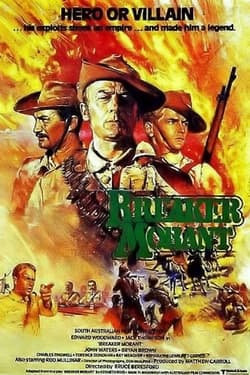
Breaker Morant and the country that adopted its scapegoat
Bruce Beresford's 1980 courtroom drama made an English-born soldier into an Australian martyr, and the picture's argument about empire has outlived its historical certainties.
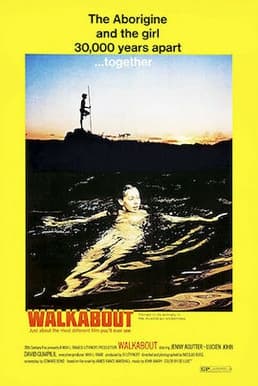
Walkabout is a British film about a country it never claims
Nicolas Roeg's 1971 picture is claimed as an Australian classic, though it was made by a Londoner, financed by two Americans and sold by 20th Century Fox. Its best argument is how little it pretends otherwise.
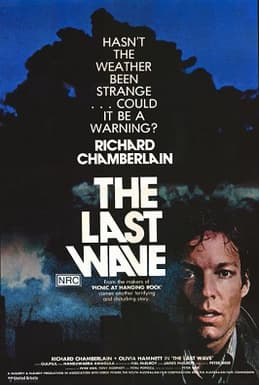
The Last Wave and the rain Sydney could not explain
Peter Weir's 1977 film puts a corporate lawyer in a drowned city and asks what a settler place owes to the ground and weather beneath it.