Rewatching Rabbit-Proof Fence and realising the fence was never the point
The film is about three girls walking home, and the walk is twelve hundred miles, and the country they cross does not want them to arrive.
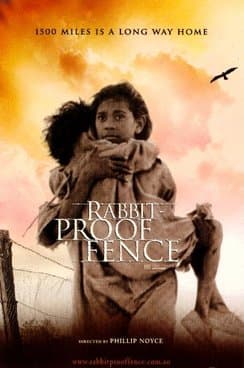
I watched Rabbit-Proof Fence again in January, which is to say I watched it during the week when the country argues about a date. I did not plan it that way. I had been meaning to rewatch it for months, and January happened to be when I finally did, and the timing turned out to matter more than I expected. There is something about watching a film about the Stolen Generations while the flags go up in the front yards that makes the experience sit differently in your chest.
The film is twenty years old now, near enough. Phillip Noyce made it in 2002, adapting Doris Pilkington Garimara’s book Follow the Rabbit-Proof Fence, which tells the true story of Pilkington Garimara’s mother Molly Craig and her cousins Daisy and Gracie. In 1931, the three girls were taken from their families in Jigalong, in the Pilbara, and sent to the Moore River Native Settlement north of Perth. They escaped and walked home. The walk was roughly twelve hundred miles. They followed the rabbit-proof fence because it ran roughly north and because it was a line in the landscape that did not require a map.
I want to say something about what the film does with walking, because the walking is the thing I remembered least accurately. In my memory of the film, the walking was heroic. Three small figures against the red landscape, determined, moving forward. And it is that. But watching it again, what I noticed is that the walking is also tedious and painful and frightening and, above all, ordinary. The girls walk. They get tired. They get hungry. They argue. Molly makes decisions and some of them are wrong and she makes another decision. They sleep in the dirt. They walk again. Noyce films this with a kind of plainness that I did not appreciate the first time around. He does not turn the walk into an adventure. He lets it be labour.
Walking as the point
The fence itself, the actual rabbit-proof fence that stretches from the north coast to the south coast, is in the film a navigational tool and nothing more. Molly follows it because it goes the right way. It has no symbolic weight for her. It is not a metaphor. It is a very long fence and she walks beside it because that is how you get home when you are fourteen and barefoot and the government has taken you fifteen hundred kilometres from your family.
I think this is what the film does best, actually. It refuses to make the fence mean something beyond its function. The title invites you to read it as a symbol of division, of settler infrastructure imposed on Country, of the arbitrariness of colonial boundaries. And you can read it that way. But the film itself is not interested in that reading. The film is interested in Molly’s feet on the ground, in the distance between where she is and where she needs to be, in the practical problem of not being caught.
This is what I mean when I say the fence was never the point. The point was always the walking. The point was always three girls deciding that they would rather walk twelve hundred miles through country that was hostile to their survival than stay in an institution that was designed to erase them. The fence is incidental. The walking is everything.
Everlyn Sampi and the problem of child performances
Everlyn Sampi was twelve or thirteen when she played Molly, and her performance is the kind of thing that film criticism tends to describe badly. People call it “natural” or “instinctive,” which is a way of saying they cannot explain how a child does what she does without the vocabulary of adult craft. But what Sampi does is specific and deliberate and precise. She holds Molly’s determination in her jaw, in the set of her mouth, in the way she looks at adults who are telling her what to do. There is a stubbornness in the performance that is not childish petulance but something harder, something that understands the stakes.
I keep coming back to a scene where Molly is told that her mother has been crying. Sampi’s face does something complicated. There is grief in it, and guilt, and a kind of resolve that says she already knew this and has already decided it does not change anything. She is still going home. Her mother’s tears are not a reason to stay. They are the reason she left.
Kenneth Branagh and the banality of administration
Kenneth Branagh plays A.O. Neville, the Chief Protector of Aborigines in Western Australia, who was the real person who authorised the removal of Molly and thousands of other children. Branagh plays him as a bureaucrat. Not a monster, not a villain with a sneer and a riding crop, but a man who sits behind a desk and looks at photographs of Aboriginal children and sorts them by skin colour and speaks about biological absorption with the calm of someone discussing crop rotation.
This was a controversial choice at the time, I think. Some people wanted the villain. They wanted Neville to be visibly cruel so that the cruelty could be located in one man and therefore contained. What Branagh does instead is show you the system. Neville is the system. He is polite and methodical and genuinely believes he is doing the right thing, and this is far worse than if he were a sadist because it means the cruelty does not require malice. It only requires paperwork and a filing cabinet and a man who thinks he knows what is best for people he has never met.
This is what I noticed on the rewatch that I did not notice the first time. The first time, I was watching the girls. The second time, I was watching Neville. And watching Neville is a different kind of horror, because it is the horror of recognition. You know this man. You have met him in offices and waiting rooms and government departments. He is reasonable. He has data. He has policies. He is going to help whether you want his help or not.
What rewatching does
I want to be careful here because I am a non-Indigenous Australian talking about a Stolen Generations film, and I am aware that my watching is not the watching that matters. The film was made from Doris Pilkington Garimara’s account of her own mother’s story. It belongs to that family and to the communities that lived it. My experience of watching it is, at best, secondary, and at worst, a kind of consumption that the film itself might not welcome.
But I think there is something worth saying about what rewatching does, specifically, as distinct from watching for the first time. The first time I saw Rabbit-Proof Fence, I was moved. The second time, I was uncomfortable in a way that was less about the film and more about the twenty years between viewings. What had I done with what the film told me the first time? What had any of us done? The Stolen Generations are not historical. They are ongoing, in the sense that the consequences are ongoing, in the sense that the systems that enabled them have not been fully dismantled, in the sense that children are still being removed from their families at rates that should make every Australian unable to sleep.
The film does not ask you to do anything. It just shows you three girls walking home. And then it is up to you what you do with that.
How the film sits now
Rabbit-Proof Fence is twenty years old and it has not dated in the way that prestige historical dramas usually date. The performances are still precise. The landscape is still that landscape. Christopher Doyle’s cinematography still finds something in the light of the Pilbara that feels like heat even on a screen. Peter Gabriel’s score is still doing perhaps too much, which is the one thing about the film that has aged visibly. The score tells you what to feel in moments when Sampi’s face is already doing that work, and the doubling weakens both.
But the film holds. It holds because it is, underneath everything, a simple story told simply. Three girls were taken from home. They walked back. The country they crossed did not want them to arrive, and they arrived anyway. That is the whole film. The fence was never the point.

Mara writes essays. She came to film writing from a decade of literary criticism and still reaches, sometimes, for a novel before she reaches for a shot list. She lives in the inner north of Melbourne and does not explain which city that is.
MORE BY MARA DENG →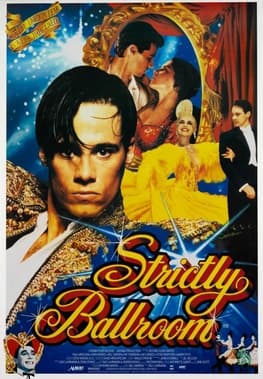
Strictly Ballroom is a film about who is allowed to teach the steps
Baz Luhrmann's 1992 comedy is sold as a story about dance. It is also a story about an Australian champion who has to be taught his own steps by a Spanish-Australian family in their own house.

Looking for Alibrandi was the first Australian story handed to me as mine
It was not my family's story. It was the shape of my family's story, put on a screen in a country that had never once bothered to hold it before.
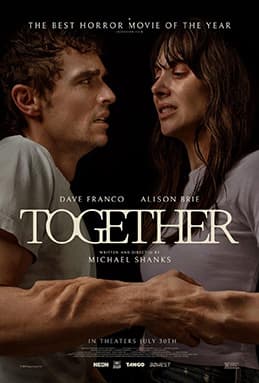
Together is an Australian horror film that learned to say trunk
Michael Shanks made a Melbourne body horror film about two people fusing into one, then sanded the Australian out of it. I keep looking for the seam.