The 2021 production pipeline closed with $1.8 billion in activity and a crew shortage
Record spending met a workforce that had spent eighteen months doing something else, and the gap showed.

The 2021 financial year ended with approximately $1.8 billion in total production expenditure across the Australian screen industry. That figure includes domestic and international productions shooting in Australia, and it represents a record. The previous high was $1.49 billion in 2018-19, itself a record at the time. By raw spending, 2021 was the biggest year Australian screen production has ever had.
The number tells one story. The production floors in Sydney, Melbourne, Gold Coast, and Adelaide tell another.
The spending breakdown
Of the $1.8 billion total, roughly $980 million came from international productions. That is Marvel, that is the large-scale American series shooting at Fox Studios and Village Roadshow, that is the feature films attracted by the Location Offset and the post-COVID exchange rate advantage. International spend was up 34 per cent on the previous year and showed no sign of slowing. The incentive structure, combined with Australia’s relatively successful pandemic management through most of 2021, made the country attractive to productions that needed stable shooting environments.
Domestic production accounted for the remaining $820 million, split roughly evenly between feature films, television drama, and documentary. Television drama spend was up 22 per cent, driven largely by streaming platform commissions from Stan, Binge, and Paramount+ entering the market. Feature film spend was flat, which in a record-spending year is effectively a decline in share.
The crew problem
Here is where the numbers become a problem. Between March 2020 and September 2021, the Australian screen workforce experienced two consecutive shocks. The first was the COVID shutdown, which halted production for approximately six months and pushed a significant portion of below-the-line crew into other industries. The second was the production surge that followed, which demanded more crew than the industry had available.
The gap is most acute in three departments: electrical, grip, and construction. These are the departments where physical skill and on-set experience matter most, where the learning curve is longest, and where the pay rates have historically been lowest relative to the physical demands. When COVID pushed crew out, many of them went into commercial construction, mining services, and event production, industries that offered more consistent work, comparable or better pay, and regular hours. When the screen industry came back, those people did not come back with it.
Estimates from the Media, Entertainment and Arts Alliance and Screen Producers Australia suggest that the effective crew pool in late 2021 was approximately 15 to 20 per cent smaller than it was in 2019, while the production volume demanding that pool was 25 per cent larger. The arithmetic is simple. There are not enough people.
What it looks like on set
The practical effects are visible across the industry. Productions that would normally crew up over four to six weeks are taking eight to ten. Heads of department are working with less experienced teams, which means more supervision time and longer setup times. Overtime is up, partly because productions are running longer days to compensate for fewer hands, and partly because the available crew can command premium rates and are working consecutive shows without breaks.
Wage pressure is real but unevenly distributed. Experienced crew in high-demand departments, key grips, gaffers, production designers, are earning significantly more than they were in 2019. Entry-level and mid-level crew are seeing smaller increases, because the demand is for experience, not bodies. A gaffer with fifteen years of experience can name their rate. A best boy with three years cannot.
What 2022 looks like from here
The pipeline for the first half of 2022 is already committed. There are at least thirty-four productions scheduled to shoot between January and June, including several large international projects at Fox Studios and Docklands. The crew shortage is not going to ease. If anything, it will intensify as these productions compete for the same reduced pool.
Three things will determine whether this becomes a structural crisis or a temporary bottleneck. First, whether the international productions that drove the 2021 spending boom continue at the same volume. Second, whether the industry can accelerate training pipelines to replace the mid-career crew that left during COVID. Third, whether wages rise enough to attract people back from the industries they moved to.
On the first question, the indications are positive. On the second, there is no evidence that training is scaling fast enough. On the third, the industry has historically resisted structural wage increases, preferring project-by-project negotiation. That resistance is about to meet a labour market that does not care about historical preferences.
The $1.8 billion headline is real. So is the workforce behind it, and the workforce is stretched thinner than it has ever been.

Odette covers the business of Australian screen. Previously a financial journalist. Reads every Screen Australia annual report the week it drops. Short paragraphs, long memory, never misses a figure.
MORE BY ODETTE MALOUF →
Screen Australia funded 112 development projects in 2025 and most will never be made
The development fund is the widest part of the funnel and the least visible, and the conversion rate tells the real story.
Screen Australia's mid-year data shows a pipeline with gaps in the middle
The top and bottom of the pipeline are functioning; the mid-budget features that sustain careers are still missing.
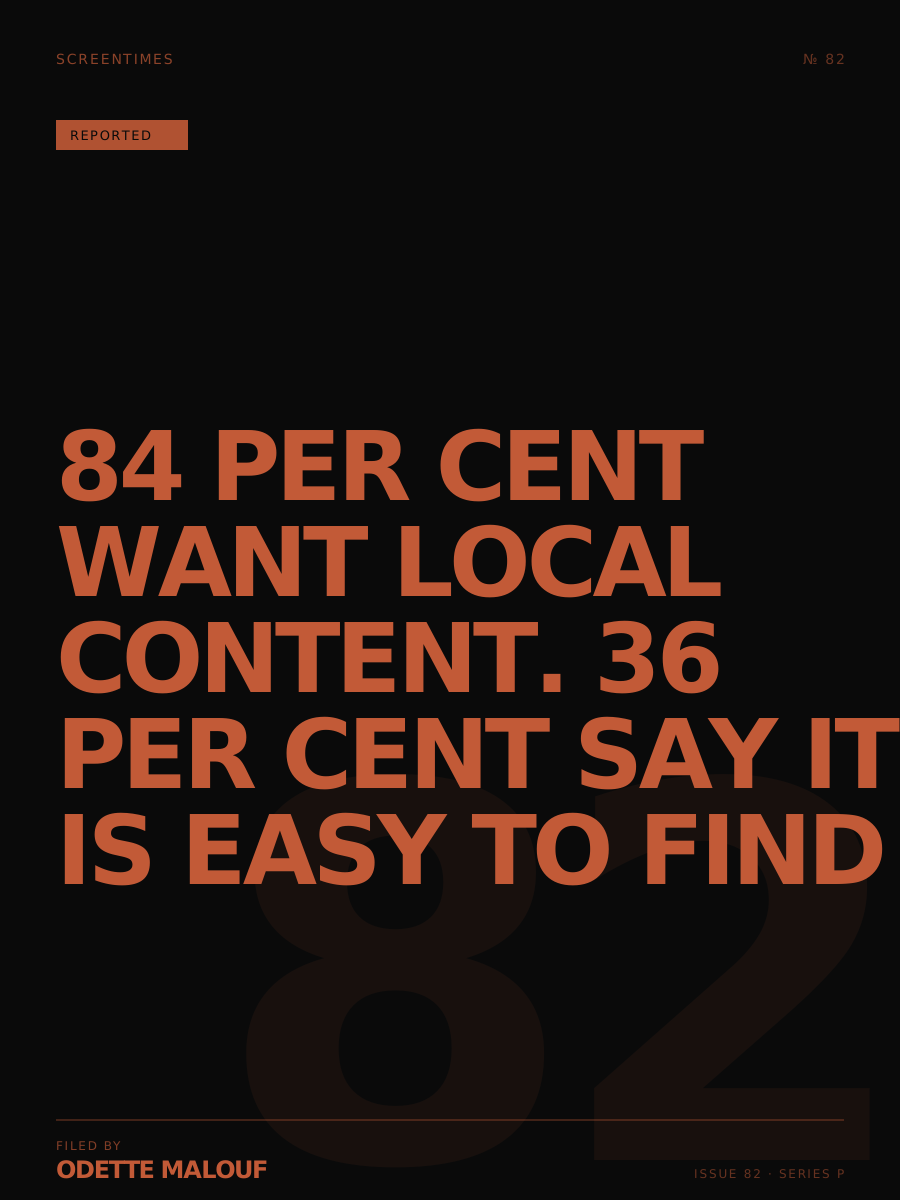
84 per cent want local content. 36 per cent say it is easy to find
Screen Australia's Screen Currency 2026 report finds strong demand for Australian screen stories and a discovery problem that no amount of production funding fixes on its own.