Mystery Road and the quiet business of not explaining
Aaron Pedersen's detective does not monologue, does not explain, and does not care whether you are keeping up.
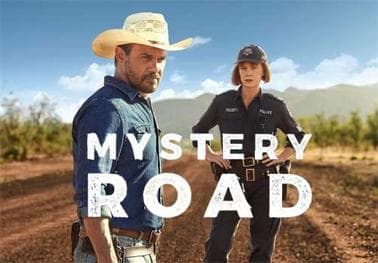
Most Australian crime dramas want to make sure you understand what is happening. They will tell you three times, through dialogue, then through a meaningful look, then through a shot of someone staring at a corkboard covered in red string. Mystery Road does not do any of that. It barely tells you once. If you missed it, that is honestly your problem, and Aaron Pedersen’s face will not be offering any follow-up commentary.
The ABC series (now two seasons deep, with a third on the way) takes the bones of Ivan Sen’s original film and stretches them across six hours of outback silence, dead cattle, and conversations where nobody says what they mean. Detective Jay Swan drives into a remote community, asks questions, gets lied to by everyone, and slowly figures out which of the lies matter. That is the show. It does not sound like much on paper, and to its credit, it does not try to be more than that on screen either.
The performance that lives in the pauses
What Pedersen does with Jay Swan is something I have genuinely not seen in Australian television before. He builds a character almost entirely out of what he withholds. There are scenes where another actor would fill the silence with a line, a reaction, something to let the audience know they should feel tense. Pedersen just stands there. He looks at the dirt. He looks at whoever just lied to him. He gets back in the car. It is extraordinary, and it is the kind of performance that award panels tend to overlook because it does not look like acting. It looks like a bloke standing in a paddock.
The refusal to over-explain extends to Jay’s identity. He is an Indigenous detective working cases in communities that do not trust cops, and the show lets that tension sit without turning it into a speech. There is no scene where Jay explains his position to a sympathetic white colleague over a beer. There is no flashback to a formative childhood moment. He is who he is, and the friction is structural, built into every interaction he has. You feel it without being told to feel it, which is (look, I know this sounds obvious) how good drama is supposed to work.
Landscape as co-writer
The other thing Mystery Road gets right, properly right, is the country itself. These are not postcard shots dropped in between scenes of people talking in kitchens. The landscape is doing narrative work. The distance between things matters. The time it takes Jay to drive from one station to another is time the show uses, because isolation is not a backdrop here, it is the mechanism. People get away with things because nobody is watching. Jay’s job is to be the person who watches, and the show keeps reminding you how much empty space he has to cover.
Compare this to something like Jack Irish (fine show, genuinely enjoy it) where Melbourne is essentially a set. It looks great, but it is not doing anything. Or The Cry, which used its Scottish and Australian locations mostly to signal mood. Mystery Road is one of the few Australian series where the geography is inseparable from the plot. Move this story to Sydney and it stops making sense. Move it to another patch of outback and the specifics change. The show knows exactly where it is.
Why nobody outside Australia seems to care
This is the part that frustrates me, hand on heart. Mystery Road is one of the best things the ABC has produced in years, and internationally it has landed with the volume of a sock hitting carpet. Part of that is distribution (Acorn TV picked it up eventually, which is fine if you are the sort of person who subscribes to Acorn TV). Part of it is that the show’s greatest strength, its refusal to rush or over-explain, makes it a difficult trailer. How do you cut a promo for a show whose best scenes are a man not talking?
There is also the uncomfortable reality that international audiences, particularly American ones, have a very specific idea of what “Australian drama” looks like. It involves either the outback as horror movie (Wolf Creek), the outback as quirky comedy (Priscilla), or a prison (Wentworth). A slow, careful, character-driven crime series about an Indigenous detective navigating racial politics in a remote community does not fit neatly into any of those boxes. It requires patience and a willingness to sit with discomfort, both of which are in short supply on streaming platforms that autoplay the next episode before the credits finish.
The writing room’s best trick
Season two shifts locations and introduces Jada Alberts as a local cop who is not especially thrilled to have Jay around. The dynamic works because neither character bends. Jay does not become warmer. Alberts’ character does not become a sidekick. They circle each other for six episodes, occasionally cooperating, never quite trusting, and the show lets that unresolved tension carry the whole thing.
The writing (across both seasons, credit to the various writers who have worked on the show) understands something that most Australian crime television does not: you do not need to resolve your characters’ personal arcs every season. Jay Swan is not on a journey toward healing or self-acceptance. He is a detective. He detects. Between cases he exists in a state of guarded, slightly tired professionalism, and the show respects that. It does not need him to grow. It needs him to pay attention, which he does, better than anyone on Australian television right now.
Honestly, just watch it. It is on iview. It costs nothing. It will not hold your hand, and it will not explain itself, and you will be better off for both of those things.

Rhys watches more television than is healthy and writes about it with a dryness that tips occasionally into cruelty. His favourite ABC drama is the one the ABC just cancelled, whichever that happens to be.
MORE BY RHYS TAVITA →
Rake was never about the cases
Eight years and five seasons of Cleaver Greene taught Australian television that you can keep a man unredeemed, and that audiences will follow him anyway.
Return to Paradise imports the cosy-crime formula and survives the flight
The ABC took Britain's most reliable comfort-crime export, moved it to a NSW beach town, and somehow the formula arrived intact.

Plum and the game that breaks the men who love it
Brendan Cowell's ABC drama is about a retired league hard-man whose head is full of poems and quietly bleeding, and it argues those are the same thing.