I Am Woman lets Helen Reddy sing and then buries her in biopic formula
Tilda Cobham-Hervey carries the voice and the conviction; the script carries the checklist.
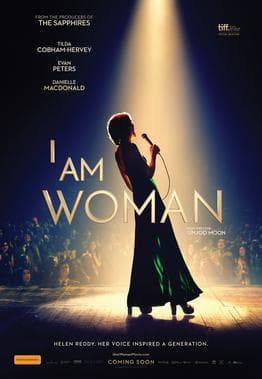
You can set your watch by the musical biopic. The childhood that establishes talent. The early struggle. The big break. The difficult relationship, usually with a man who is either the problem or the solution, frequently both. The crisis, which in a music biopic means either drugs, professional betrayal, or a period of creative drought. The recovery. The performance that proves the subject was right all along. The end title cards. The real footage over the credits. The audience leaving the cinema feeling warm and informed and not a single degree closer to understanding what made the subject’s music matter.
I Am Woman (Unjoo Moon, 2019) follows this template with a fidelity that borders on the devotional. Helen Reddy arrives in New York from Melbourne with her young daughter and three hundred dollars. She is talented. She is determined. She is Australian, which in the film’s telling means she is underestimated by an American industry that does not know what to do with her accent or her ambition. She meets Jeff Wald (Evan Peters), a music manager who is charismatic and volatile in the way that male characters in music biopics are always charismatic and volatile. They marry. He manages her career. The career rises. The marriage deteriorates. The song gets written. The song changes everything.
The song, of course, is “I Am Woman,” and the film understands that the song is the reason the film exists. What it does not entirely understand is why.
What Cobham-Hervey brings
Tilda Cobham-Hervey’s performance is the best thing in the picture, and it is not close. She plays Reddy with a physical specificity that goes well beyond mimicry: the posture, the way Reddy held a microphone, the particular set of her mouth before she sang, the shift in her body language between private uncertainty and public command. Cobham-Hervey does not impersonate Reddy. She inhabits the architecture of the woman and then fills it with her own emotional intelligence, which is considerable.
The physical transformation is worth noting because Cobham-Hervey, who is slight and fine-featured, does not look like Reddy, who was broader, more solid, more physically present. But Cobham-Hervey finds Reddy in the way she occupies space: the widening of the stance as confidence grows, the way she learns to take up room on a stage that the industry would prefer her to share. There is a moment in a recording studio where Cobham-Hervey listens to a playback and her face moves through three distinct emotions in under two seconds, none of them signposted by the dialogue, and it is the kind of acting that makes the surrounding film look like it is working at half her level.
Which it is.
The Australian in Hollywood
The film’s treatment of Reddy’s Australian identity is interesting when it appears and frustrating when it disappears, which is often. Reddy arrived in the United States in 1966, having won a talent contest on the television programme Bandstand that included a ticket to New York. She was not a naif. She was a professional performer from a family of performers, and her understanding of the entertainment industry was practical rather than romantic. The film captures some of this: there is a good early sequence where Reddy navigates the New York club scene with the specific competence of someone who has been performing since childhood and knows exactly what she is worth, even if no one else does yet.
But the Australian dimension fades as the narrative progresses, replaced by a generic immigrant-makes-good story that could be set in any origin country. Reddy’s Australianness becomes a flavour note rather than a structural element, and the film misses an opportunity to examine what it meant, specifically, to be an Australian woman in the American music industry of the early 1970s: the assumptions about capability, the invisibility of a cultural background that Americans could not easily categorise, the particular loneliness of being from a country that the industry regarded as a novelty rather than a source.
The biopic problem
Musical biopics keep making the same mistakes because the format rewards them for it. The structure, the rise-and-fall-and-rise arc, is commercially reliable because it delivers emotional satisfaction regardless of its relationship to the truth. The audience knows the shape of the story before the opening titles. They know the character will suffer and prevail. They know the final performance will be triumphant. This foreknowledge creates a comfort that audiences enjoy and studios value, and it is also the thing that prevents most musical biopics from being good films rather than competent ones.
I Am Woman is competent. The pacing is professional. The period detail is convincing without being ostentatious. The supporting performances are adequate: Peters does what the role requires as Jeff Wald, though the role requires him to be a type rather than a person, and Danielle Macdonald brings warmth to the underwritten role of journalist Lillian Roxon, whose friendship with Reddy the film treats as important and then abandons for the more conventional dramatic engine of the marriage.
What the film does not do is interrogate its own form. It does not ask whether the biopic structure is adequate to the story of a woman whose significance was political as much as musical. The song “I Am Woman” became an anthem of the second-wave feminist movement. It was played at rallies. It was quoted in congressional testimony. It meant something to millions of women that exceeded its qualities as a pop song, and that meaning was generated not by Reddy’s biography but by the cultural moment in which the song appeared. A film that wanted to capture that meaning would need to break the biopic mould, to move outward from the individual into the collective, to show how a song escapes its singer and becomes property of the audience.
What it gets right despite itself
And yet. There are scenes in I Am Woman that work in spite of the formula, and they work because Cobham-Hervey and Moon find moments of specificity within the generic structure. There is a scene where Reddy performs at a women’s rights benefit and the camera moves from her face to the faces in the audience, and for thirty seconds the film becomes about what the song does rather than what it is, and in those thirty seconds you can see the film this might have been.
There is a scene where Reddy writes the lyrics of “I Am Woman” on scraps of paper, and the writing is not presented as inspiration but as labour: crossing out, rewriting, testing phrases against the feeling she is trying to articulate. Cobham-Hervey plays this scene with the concentration of someone solving a practical problem, not receiving a gift from the muse, and the ordinariness of the creative process, the sheer work of finding the right words, is more revealing than any amount of biographical montage.
Moon, directing her first feature, shows a sensitivity to performance and a visual confidence that the screenplay does not always serve. She is good with faces. She is good with the physical dynamics of a recording studio or a stage. She is less well served by a script that insists on moving through the biographical checkpoints at a pace that leaves no room for the kind of extended, specific observation that the best scenes achieve. The film needed either fewer events or more time, and it got neither.
Helen Reddy died in September 2020, the same year the film was released in Australia. She was 78. The timing gives the film an elegiac quality it did not earn on its own terms, and that feels like a final irony: a woman whose greatest contribution was a song about self-determination, commemorated by a film that follows the formula instead of breaking it. Cobham-Hervey deserved a sharper script. Reddy deserved a stranger film. The performance survives the picture, which is, when you think about it, exactly what the real Helen Reddy spent her career doing: surviving the structures that were supposed to contain her.
Bronte writes long-form criticism of Australian cinema and the international art films that feed into it. She was on the ground at Cannes in 2019 and has not entirely forgiven the festival for 2020. Patient with slow films; impatient with tidy ones.
MORE BY BRONTE HAUGHEY →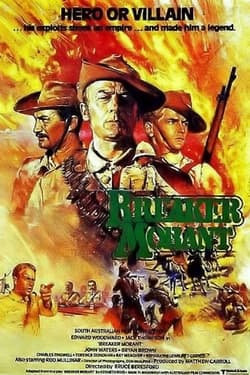
Breaker Morant and the country that adopted its scapegoat
Bruce Beresford's 1980 courtroom drama made an English-born soldier into an Australian martyr, and the picture's argument about empire has outlived its historical certainties.
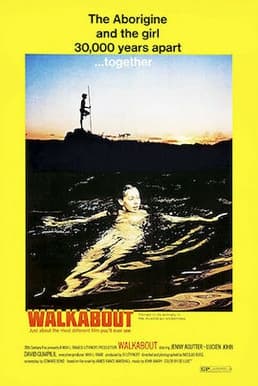
Walkabout is a British film about a country it never claims
Nicolas Roeg's 1971 picture is claimed as an Australian classic, though it was made by a Londoner, financed by two Americans and sold by 20th Century Fox. Its best argument is how little it pretends otherwise.
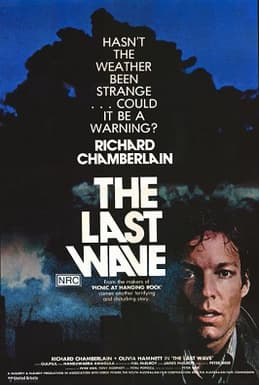
The Last Wave and the rain Sydney could not explain
Peter Weir's 1977 film puts a corporate lawyer in a drowned city and asks what a settler place owes to the ground and weather beneath it.