Hollywood keeps filming in Australia and asking Australia to pretend it is somewhere else
The studios come for the crews, the tax breaks, and the light, and they leave with a film set in Chicago, or Oakland, or a planet that does not exist.

There is a scene in Clickbait where a character drives through Oakland, California. The houses look right. The light looks right. The lawns are the right kind of brown. I watched it and I thought, that is Melbourne. Not because I recognised a specific street or a particular building, but because something in the way the light hit the pavement was familiar in a way I could not place until I looked it up and confirmed what I already suspected: the entire series was shot in Melbourne, dressed and graded and digitally adjusted to look like the Bay Area.
Melbourne played Oakland. Melbourne did a good job. Nobody in the American audience thought about Melbourne at all, which was the point.
I keep thinking about this. Not as a complaint, exactly, but as a condition. Australian cities and landscapes have been doubling for other places for decades, and the arrangement works well enough that it has become one of the foundational facts of the Australian screen industry. The studios come. They bring money. They hire Australian crews, fill Australian sound stages, eat at Australian restaurants, and they leave with a product that is set in Chicago or San Francisco or a fantasy realm where the question of geography does not arise. The work stays here. The story does not.
The economics of invisibility
I want to be clear about something: the economic argument for this arrangement is real and it matters. When Mortal Kombat shot in Adelaide in 2019, it brought roughly $70 million into the South Australian economy. The production hired hundreds of local crew members. It used local facilities, local services, local expertise. Adelaide’s new studio infrastructure exists in part because productions like this chose to come, and those facilities do not disappear when the trucks leave. They stay. They make the next production possible, and the one after that.
The same arithmetic applies on the Gold Coast, where Village Roadshow Studios has hosted a rolling catalogue of American blockbusters. Godzilla vs. Kong shot there. Thor: Ragnarok shot there. Aquaman shot there. The Gold Coast played Skull Island, Sakaar, Atlantis, and a version of the Pacific Ocean that does not correspond to any particular latitude or longitude. The hinterland doubled for alien jungles. The beaches doubled for somewhere that was not the Gold Coast. The crew worked sixty-hour weeks building worlds that bore no resemblance to the world outside the studio gate, and they were paid well for it, and the money moved through the local economy, and this is not nothing.
Sydney got Shang-Chi and the Legend of the Ten Rings, which meant that parts of western Sydney became San Francisco and parts of the city became Macau and parts of it became a pocket dimension accessible only through a magical pendant. The production used Fox Studios and various locations around the city, and the result was a film in which Sydney is everywhere and nowhere, present in every frame and acknowledged in none, unless you count the credits, which most people do not read.
The craft of disappearing
What interests me is not the economics, which are straightforward, but the craft. The people who make Australian locations disappear are extraordinarily good at their jobs. The production designers, the location scouts, the colourists, the VFX artists who paint out a Hills Hoist or replace a eucalyptus with an oak. These are skilled professionals doing precise, demanding work, and the measure of their success is that nobody notices they were there. The better they do their job, the more invisible they become. There is something in this that feels worth sitting with.
I talked to a location scout once, years ago, at a wrap party for something I have forgotten the name of. She told me that the skill is not in finding a place that looks like somewhere else. It is in finding a place that looks like nowhere, a blank enough canvas that the production can project whatever it needs. Shopping centres with generic facades. Suburban streets with the right width and the right kind of tree canopy, or no tree canopy, which is easier. Industrial zones that could be anywhere because industrial zones are designed to be anywhere. The ideal location, she said, is one with no personality.
I found this fascinating and slightly depressing. The qualities that make a place interesting to live in are the qualities that make it unsuitable for doubling. Melbourne’s laneways, its trams, its particular quality of winter light: these are the things that make Melbourne feel like Melbourne, and they are the things that have to be erased or avoided when Melbourne is pretending to be Oakland. The city’s identity is a problem to be solved.
The question that will not settle
So here is where I arrive, and I want to be careful because the argument can go somewhere unhelpful if you push it too far. Does it matter? Does it matter that the work is here but the story is not? Does it matter that Australian crews are building worlds they are not allowed to inhabit on screen, that the physical labour of Australian grips and sparks and art department runners is embedded in films that pretend to be from somewhere else?
The economic answer is: no, it does not matter, because money is money and employment is employment and the alternative is that the productions go to Vancouver or Prague or wherever the next tax incentive is most generous, and then the crews have no work at all, and the stages sit empty, and the restaurants near the studios close. This argument is correct as far as it goes.
But there is another answer, which is harder to quantify. Every time an Australian city doubles for an American one, it reinforces a hierarchy. The American story is the one worth telling. The American city is the one worth seeing. The Australian location is raw material, a surface to be written on, useful precisely to the extent that it can be made to resemble something else. I do not think anyone involved in these productions thinks about it this way, and I do not think they should have to. They are doing their jobs. They are doing them well. But the pattern is there, underneath the call sheets and the tax offset applications, and I cannot stop noticing it.
What the credits do not say
I watched Mortal Kombat when it came out. It was fine. Adelaide played a series of fantastical locations, and the fights were loud, and the plot was the kind of plot that exists to connect one fight to the next. At no point during the film did I think about Adelaide. That was the job, and the job was done. But afterwards, walking home, I thought about the hundreds of people who had spent months in a South Australian summer building sets for a world that does not exist, and I wondered what it felt like to watch the finished product and see no trace of the place where you actually stood, the place where you drank your coffee and parked your car and checked your phone between setups.
The credits list names but not places. They say who worked on the film but not where the work happened. There is a production acknowledgement, sometimes, a line about the South Australian Film Corporation or Screen Queensland or whichever state body provided the offset. But the audience does not read it. The audience sees Outworld, or Oakland, or the Negative Zone, and the Australian-ness of the production evaporates, which is exactly what everyone agreed it would do, which is exactly the arrangement, which is exactly my problem with it, or not my problem, exactly, but the thing I keep turning over, the thing I cannot quite resolve.
Australian crews are among the best in the world. The studios know this. They keep coming back. They bring their stories with them and they take their stories when they leave, and what stays is the money and the infrastructure and the skills and a long list of films in which Australia is everywhere and nowhere, felt but not seen, present but not named. I do not know if this is a fair trade. I suspect it is the only trade on offer, and I suspect that knowing this does not make it easier to watch Melbourne pretend to be Oakland and do it so well that nobody thinks to ask where they actually are.

Mara writes essays. She came to film writing from a decade of literary criticism and still reaches, sometimes, for a novel before she reaches for a shot list. She lives in the inner north of Melbourne and does not explain which city that is.
MORE BY MARA DENG →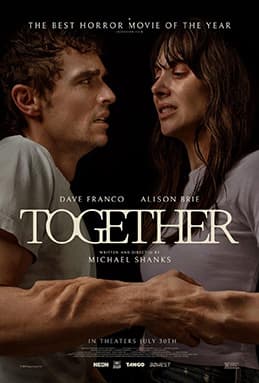
Together is an Australian horror film that learned to say trunk
Michael Shanks made a Melbourne body horror film about two people fusing into one, then sanded the Australian out of it. I keep looking for the seam.
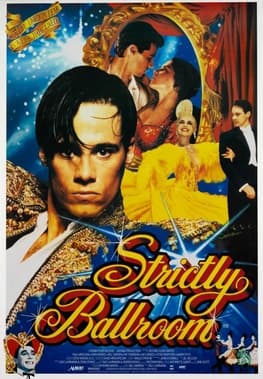
Strictly Ballroom is a film about who is allowed to teach the steps
Baz Luhrmann's 1992 comedy is sold as a story about dance. It is also a story about an Australian champion who has to be taught his own steps by a Spanish-Australian family in their own house.

Looking for Alibrandi was the first Australian story handed to me as mine
It was not my family's story. It was the shape of my family's story, put on a screen in a country that had never once bothered to hold it before.